SRI Seminar Series continues in fall 2025 with leading voices on technology and society
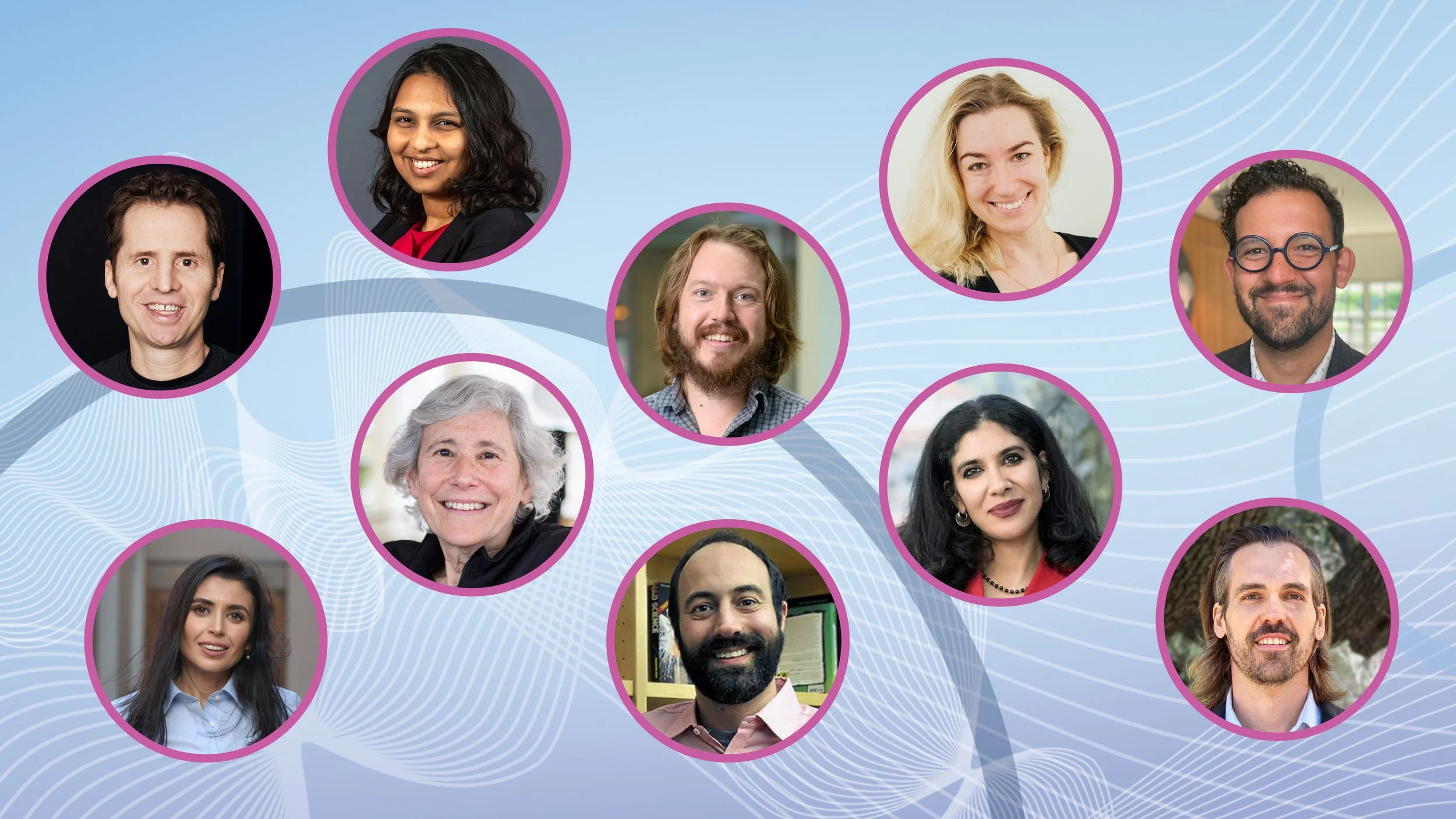
A new lineup of scholarly voices joins more than 100 previous speakers in the SRI Seminar Series, returning this fall with live and in-person events.
The Schwartz Reisman Institute is proud to announce its SRI Seminar Series programming for Fall 2025. This semester, an extraordinary lineup of scholars, technologists, and legal thinkers will examine urgent issues at the intersection of technology, governance, and society. Through thought-provoking presentations of new research and ideas, the series will explore topics ranging from the ethics of artificial intelligence (AI) in education and the creative industries, to the governance of advanced AI systems, to the social and political dynamics of democratic engagement in the digital age.
Since its inception in 2020, the SRI Seminar Series has hosted over 100 speakers across more than 20 disciplines, attracting thousands of participants from around the world. Designed to foster interdisciplinary dialogue among academics, policymakers, industry experts, and the public, these weekly seminars are free and open to all. They take place online on Wednesdays from 12:30 to 2:00 PM ET, with one select event in partnership with University of Toronto departments and institutes.
The Fall 2025 program begins on September 17 with Jeff Clune, professor of computer science at the University of British Columbia and a Canada CIFAR AI Chair at the Vector Institute. Clune will discuss his pioneering work on open-ended and AI-generating algorithms—systems inspired by evolution and human culture that innovate indefinitely, producing a rich diversity of high-quality solutions rather than converging on a single “best” answer. His talk will also touch on his broader research in AI safety, interpretability, robotics, and artificial life.
The following week, on September 24, Hasma Bastani, associate professor at the University of Pennsylvania’s Wharton School, will share results from a large-scale field experiment testing generative AI’s impact on student learning. Comparing a standard GPT-4 interface to a safeguarded “GPT Tutor,” Bastani’s team found that while both improved short-term performance, unrestricted use could harm long-term retention—underscoring the importance of careful AI design in education.
On October 1, SRI Faculty Affiliate Anastasia Kuzminykh of U of T’s Faculty of Information will explore human interaction with AI systems, particularly human-agent communication supported through conversational user interfaces. Up next, on October 8, Ryan Calo, professor at the University of Washington School of Law, will discuss his new book Law and Technology: A Methodical Approach (Oxford University Press, 2025), which offers a systematic framework for legal analysis of emerging technologies and argues for treating “law and technology” as a distinct field in its own right.
On October 15, presented both in person and online in partnership with the Department of Computer Science’s C.C. “Kelly” Gottlieb Distinguished Lecture Series, Schwartz Reisman Chair in Technology and Society David Duvenaud, an associate professor in U of T’s Department of Computer Science, will speak on AI safety, off the back of his recent op-ed in The Guardian and workshop at U of T.
On October 22, Peter Salib of the University of Houston Law Center will turn to AI governance, examining whether granting certain rights to AI systems could serve as a novel pathway to protecting human safety.
In November, the Seminar Series will spotlight the societal and ethical dimensions of advanced technologies. On November 5, attendees will hear from Lucy Suchman, professor emerita in the Department of Sociology at Lancaster University and a pioneering figure in human-computer interaction, who has recently interrogated the topic of automation of military systems, exploring whose bodies are incorporated into these technologies and with what consequences for justice and the possibility of peace. On November 12, Sonia Katyal, professor at the University of California Berkeley School of Law and co-director of the Berkeley Center for Law & Technology, will address how generative AI and restrictive licensing are reshaping creativity in her talk “Art in walled gardens.” Drawing from intellectual property and contract law, Katyal will explore the risks of a “permission culture” in which access to creative materials—and even AI’s own generative capacity—is constrained by private contractual control, with profound implications for openness and innovation.
On November 19, Brad Knox of the University of Texas at Austin will discuss his work on aligning the objectives of learning agents with human goals, combining insights from reinforcement learning, robotics, and human-computer interaction to design AI systems that faithfully reflect user intent.
The Fall 2025 series concludes on November 26 with SRI Faculty Fellow Semra Sevi, assistant professor in the University of Toronto’s Faculty of Arts and Science, presenting her research on chatbot-driven voting aid applications. Sevi’s “VAA Bot” uses large language models and retrieval-augmented generation to deliver balanced, personalized election information drawn from official party documents. Across three experimental studies with young adults, the tool was shown to improve knowledge of party positions but had weaker effects on vote preferences and party evaluations—findings that highlight both the promise and the limitations of LLM-based tools for civic learning.
Recordings of previous seminars are available on SRI’s YouTube channel, enabling the broader community to engage with these important conversations at their own pace.
The fall 2025 SRI Seminar Series promises to continue the Institute’s tradition of bringing leading thinkers together to confront the societal challenges and opportunities of technological change.
Don’t miss your chance to take part in these discussions—register now to attend upcoming seminars.
Want to learn more?
Browse stories by tag:
- AI
- AI safety
- AI trust
- Computer science
- Computer security
- Copyright
- Cybersecurity
- Data
- Economics
- Education
- Engineering
- Ethics
- GPO-AI
- Governance
- Health
- Human Rights
- In the Media
- Jobs
- LLMs
- Law
- Normativity
- Philosophy
- Privacy
- Privacy Series
- Psychology
- Public Policy
- Recommenders
- Regulation
- Reports
- Trust
- Workshops