Research
Integrating research across traditional boundaries to deepen our knowledge of technologies, societies, and what it means to be human.
Research Overview

Developing new methods for exploring the ways technology, systems, and society interact.
The Schwartz Reisman Institute for Technology and Society (SRI) supports ground-breaking interdisciplinary research on the social impacts of advanced technologies by bringing together scholars from STEM, social sciences, and humanities fields to spark new conversations, ideas, and approaches. Our community comprises 180+ researchers from the University of Toronto, encompassing 65+ different faculties and departments and 28 unique academic disciplines.
Comprising diverse areas of inquiry—from safe and aligned AI development, fairness in machine learning, trusted data sharing, and AI for social good to legal design, systems of governance, ethics, education, and human rights—our research agenda crosses traditional boundaries and is fundamentally inspired by a commitment to reinventing from the ground up.
We seek to increase the range and depth of interdisciplinary research in the AI and society ecosystem at the University of Toronto and beyond through ongoing initiatives such as our seminars, discussion groups, conferences, and workshops. We support scholars across disciplines to foster new research programs, and connect cross-disciplinary research teams to grants and philanthropy initiatives.
We foster and advance new fields of research to deepen our understanding of how powerful technologies are reshaping our world. This includes developing novel areas of research, promoting new collaborations, and helping to grow a community of diverse, globally-engaged scholars.
Our work contributes to new forms of governance for powerful new technologies by integrating technical solutions and social analyses with legal and regulatory frameworks. Our focus is to develop democratic, agile, and efficient governance that works at a global scale, addressing growing gaps between the public and private sectors, and aligning technology with human agency and values.
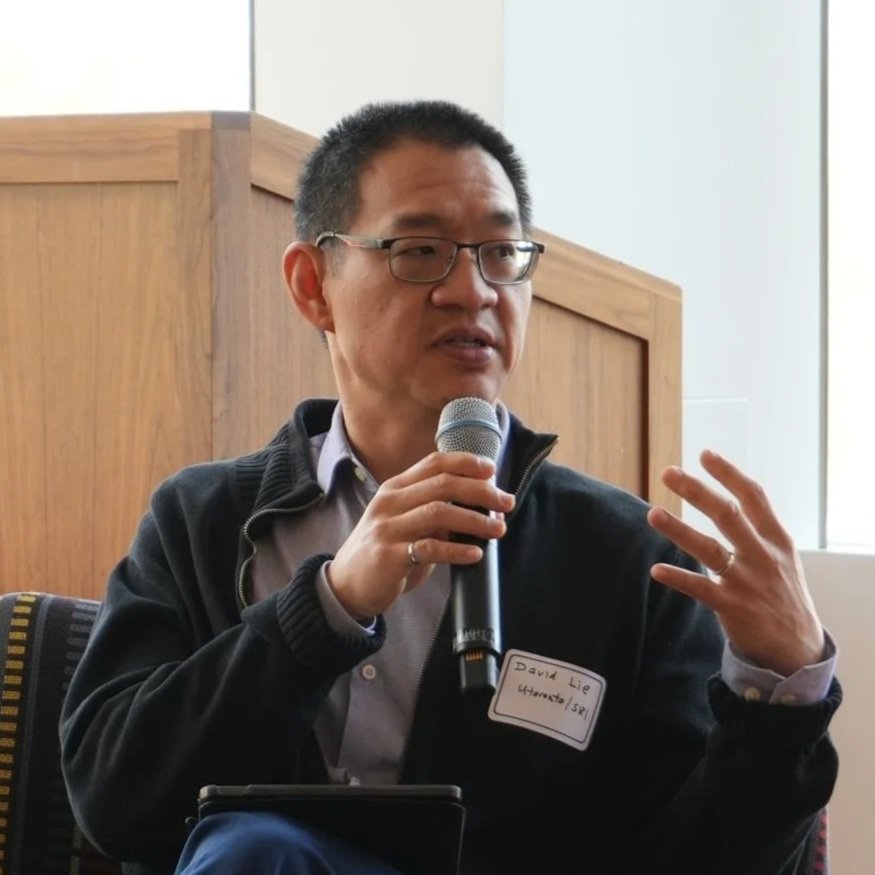
David Lie is developing techniques to ensure AI models are robust, fair, and interpretable, and establishing guidelines for AI use to ensure regulatory compliance.

Sheila McIlraith’s research explores how to build safe and human-compatible AI systems, and she co-leads the Embedded Ethics Education Initiative.

Beth Coleman is exploring how trust influences our interactions with AI systems and frameworks to be integrated into new forms of policy design.

Karina Vold has been recognized with an AI2050 Early Career Fellowship from Schmidt Futures for her research on the social and ethical implications of AI technologies.
Research Initiatives

An End-to-End Approach to Safe and Secure AI Systems
SRI Director David Lie is leading a $5.6 million initiative to make AI systems safer and more secure from end to end. Funded jointly by NSERC and the Communications Security Establishment, An End-to-End Approach to Safe and Secure AI Systems brings together 19 researchers across four Canadian universities, six of them from SRI. The project spans methods for training AI models in low-data environments, techniques for improving robustness and fairness, formal verification, and compliance frameworks organizations can put into practice. The premise is that AI safety is a pipeline problem rather than a model problem: weaknesses introduced at the data stage carry through training and deployment, and controls applied at any single point won't catch them.

Post-AGI Civilizational Equilibria
The Post-AGI Workshop brings together leading researchers to explore how society might evolve after the development of transformative, controllable AGI. Led by Schwartz Reisman Chair David Duvenaud, the workshop series examines how advanced AI could reshape economic structures, cultural life, and global governance. With speakers from institutions including Stanford, Google DeepMind, Oxford, and the University of Toronto, the event fosters interdisciplinary collaboration across machine learning, political science, economics, philosophy, and history. It aims to deepen understanding of post-AGI futures and nurture a growing research community focused on long-term societal impacts of advanced AI. The workshop was first presented in July 2025 at ICML in Vancouver, with follow up workshops in December 2025 at NeurIPS in San Diego, and in 2026 at Lighthaven.

Responsible Intelligence, Safety and Education (RISE)
SRI inaugural Global Fellow Kaitlyn Regehr leads the Responsible Intelligence, Safety and Education (RISE) initiative, which will be launched publicly in late 2026. RISE is a large-scale digital and AI awareness-building campaign that aims to work across research-intensive universities around the world. Grounded in a public health model, the initiative will build understanding and engagement around how AI is shaping society—particularly its impacts on children, young people, and their futures. Drawing on evidence-based research, the project aims to equip the public with the knowledge required to make informed decisions and to catalyze collective action that can ultimately inform policy and legislative change. More information on RISE will be made available in December 2026.
Rights & AI Network
SRI Research Lead Anna Su convenes the Rights & AI Network, a multidisciplinary working group examining how AI systems strain human rights frameworks built for a world of human decision-makers. Across four research streams—foundational rights concepts, digital constitutionalism, emerging rights claims including AI personhood, and the material conditions of AI—members drawn from law, the social sciences, civil society, and government meet monthly through winter 2027, culminating in an in-person workshop at the University of Toronto in summer 2027.

AI & Trust Working Group
The AI & Trust Working Group is a multinational, transdisciplinary initiative led by Beth Coleman that examines how trust in AI is formed, challenged, and sustained across social, technical, and institutional contexts. Bringing together 65 participants from academia, industry, government, and civil society, it explores how trust operates in human–AI interactions, how institutions demonstrate trustworthiness, and how cultural and political contexts shape public confidence in emerging technologies. Through collaborative research across three thematic clusters—governance, law and rights, and community experience—the group develops shared frameworks, case studies, and policy insights that address the multifaceted nature of trust. Its work aims to clarify what trustworthy AI entails, supporting institutions and policymakers in designing accountable systems, and advance a more holistic understanding of how AI can serve democratic values and societal wellbeing.

Embedded Ethics Education Initiative
A collaboration between the University of Toronto’s Department of Computer Science and Schwartz Reisman Institute for Technology and Society in association with the Department of Philosophy, the Embedded Ethics Education Initiative (E3I) is a teaching and learning venture that embeds paired ethics-technology education modules into undergraduate computer science courses. As challenges such as AI safety, data privacy, and misinformation become increasingly prevalent, E3I provides students with the ability to critically assess the societal impacts of the technologies they will be designing and developing throughout their careers. Led by Sheila McIlraith, Diane Horton, David Liu, and Steven Coyne, E3I engages thousands of undergraduate students at U of T every year, and is currently being piloted in other STEM disciplines at the university.

Global Public Opinion on Artificial Intelligence
The Global Public Opinion on Artificial Intelligence (GPO-AI) is a report by the Schwartz Reisman Institute for Technology and Society in collaboration with the Policy, Elections, and Representation Lab (PEARL) at U of T’s Munk School of Global Affairs & Public Policy, led by Peter Loewen. The report examines public perceptions of and attitudes toward AI conducted in 12 languages across 21 countries, with more than 23,000 responses, and includes commentaries on consumer use of AI systems, questions of justice and labour, and insights on global attitudes towards AI, as well as how these attitudes differ across countries and regions. The report was released in May 2024, with findings included in the Stanford Institute for Human-Centred Artificial Intelligence (HAI)’s 2024 AI Index Report and presented at SRI’s Absolutely Interdisciplinary 2024.
Research Programming

SRI Graduate Fellowships
The Schwartz Reisman Institute for Technology and Society supports innovative research at the University of Toronto through its Graduate Fellowships program, which are awarded annually to projects exploring the social impacts of advanced technologies through interdisciplinary approaches. Since 2020, the Institute has awarded more than 100 fellowships with a total value of more than $1M. SRI’s call for graduate fellowships is announced annually at the end of November, with the deadline in February. Graduate students from across all U of T campuses are eligible to apply.

SRI Seminar Series
The SRI Seminar Series explores cutting-edge research on how the latest developments in AI and data-driven systems are impacting society. From ethics to engineering, law, computer science, and beyond, SRI Seminars offer a wide range of perspectives into new ideas, building bridges across disciplines. Since 2020, the series has established itself as a key convenor for the SRI community and beyond, hosting more than 100 talks. Notable guests include: Luciano Floridi (Yale), Cynthia Dwork (Harvard), Iason Gabriel (Google DeepMind), Barbara Grosz (Harvard), Jon Kleinberg (Cornell), Arvind Narayanan (Princeton), Seth Lazar (ANU), Shannon Vallor (U. Edinburgh), Sanmi Koyejo (Stanford), and Helen Nissenbaum (Cornell). Recordings of select sessions are available on SRI’s YouTube channel, serving as a valuable resource for researchers, educators, and students.
Discussion Groups

Toronto AI Safety Discussion Group
The AI Safety Discussion Group brings together researchers from the Schwartz Reisman Institute, the Vector Institute and the University of Toronto’s Department of Computer Science to examine how AI systems can be made safe, reliable and aligned with human values. Since 2021, the group has met roughly monthly to discuss recent papers and research, with presentations from local and visiting researchers on topics including interpretability, reward and side-effect specification, adversarial robustness, machine unlearning, human oversight and AI governance. Sessions are informal and open to anyone interested. To receive announcements, join the AI safety mailing list.

SRI Privacy Discussion Group
SRI's Privacy Discussion Group brings together students, faculty and practitioners from computer science, engineering, law, policy and the social sciences. Our monthly conversations connect technical research with legal and social perspectives on timely privacy questions—from AI companions and deepfakes to neurotechnology, mass surveillance and children's privacy. The group offers an informal space to share work in progress, get feedback and build connections beyond your own field. Bring a paper, suggest a topic, explore an early idea or simply join the conversation! You do not need expertise in every area: your questions and perspectives help shape the discussion. Visit the SRI Privacy Discussion Group website, or join our mailing list.

Critical NLP Discussion Group
The Critical NLP Discussion Group seeks to shift natural language processing (NLP) beyond the dominant heuristic practice by grounding it in rigorous theoretical and interdisciplinary discourse. Our aim is to foster dialogue shaped by diverse fields, encouraging critical reflection, shared learning, and the development of more socially grounded perspectives and methods in NLP. We hold open discussions with no assigned reading: participants bring any paper they have read recently (or pick one at the start of the session) and examine it through one or more of three lenses:
Bring a positive claim: What claim would you defend?
Practices on trial: What practice does it take for granted?
Epistemic shift: What idea from outside NLP would reframe it?
The group meets biweekly, and all U of T students, faculty, and affiliates are welcome to participate. If you would like to join online, please email the group organizers.

Toronto Systems Security Lab
Led by SRI Director David Lie, professor in the Edward S. Rogers Sr. Department of Electrical and Computer Engineering and Canada Research Chair in Secure and Reliable Systems, the Toronto Systems Security Lab (TossLab) works to make the computer systems we rely on every day more secure, trustworthy, transparent and privacy-preserving. Drawing on operating systems, computer architecture, formal verification and networking, the group builds working prototypes to uncover and address vulnerabilities in everything from cloud infrastructure and GPUs to web applications and privacy policies. Its recent work includes GPUBreach, which won a Distinguished Paper Award at IEEE S&P 2026, and new research using LLMs to find software bugs and verify network protocols.

Periscope
Led by SRI Research Lead Karina Vold, associate professor at the University of Toronto’s Institute for the History and Philosophy of Science and Technology, Periscope is a philosophy research lab exploring the future of human and artificial cognition. Bringing together postdoctoral researchers and graduate and undergraduate students, the lab examines how AI and other cognitive technologies, such as brain-computer interfaces and generative models, are reshaping how we think, learn, and make decisions. Its projects span AI safety and alignment, AI in medicine and health care, how humans can learn from AI-driven scientific discovery, algorithmic bias in Canada, and the ethics of technologies that extend the human mind.
Latest Research Stories