
Who We Are
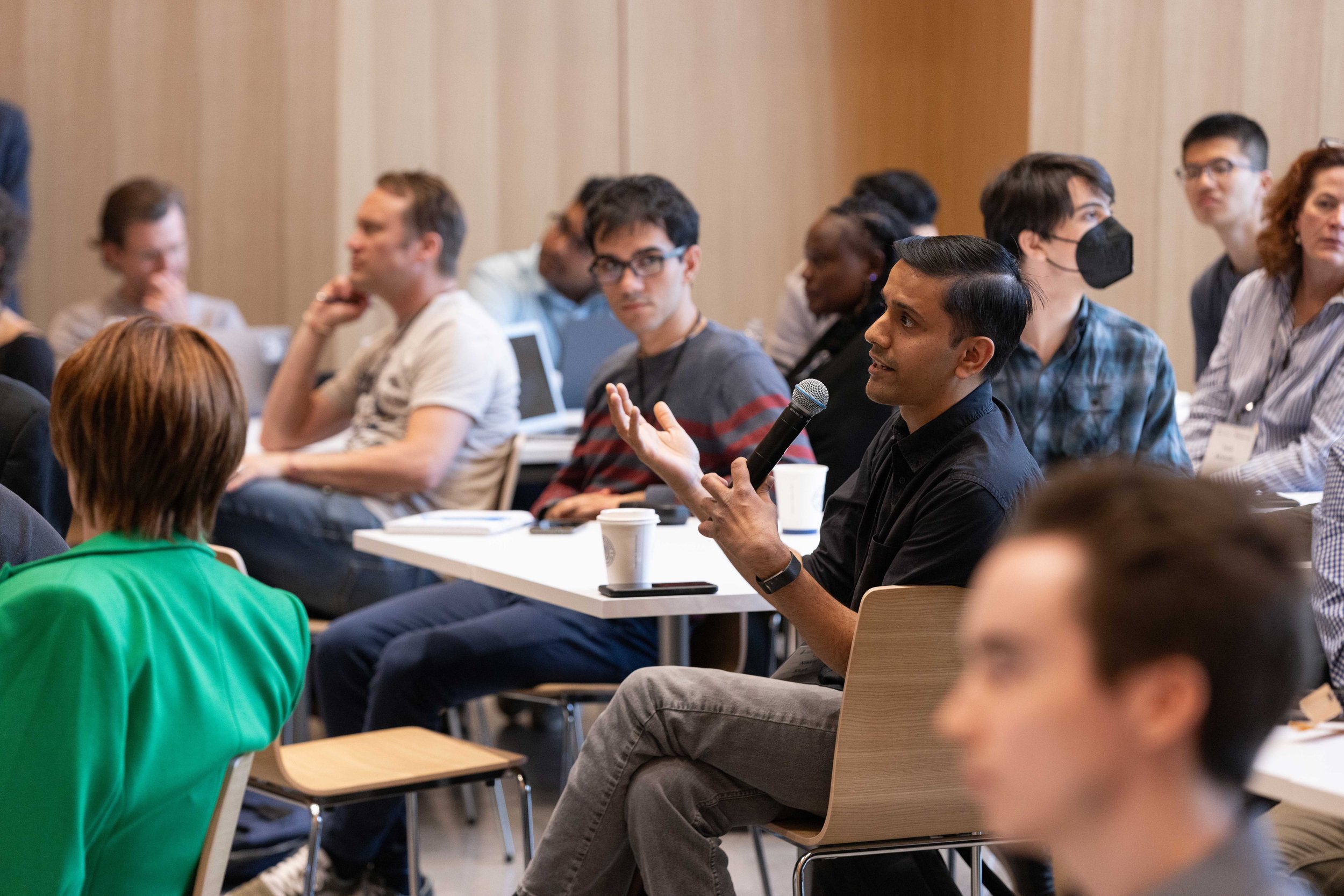
The Schwartz Reisman Institute for Technology and Society (SRI) is a research and solutions hub at the University of Toronto dedicated to deepening understanding of technologies, societies, and what it means to be human.
SRI integrates research across traditional boundaries and builds practical, implementable solutions that really make a difference.
Institute Leadership
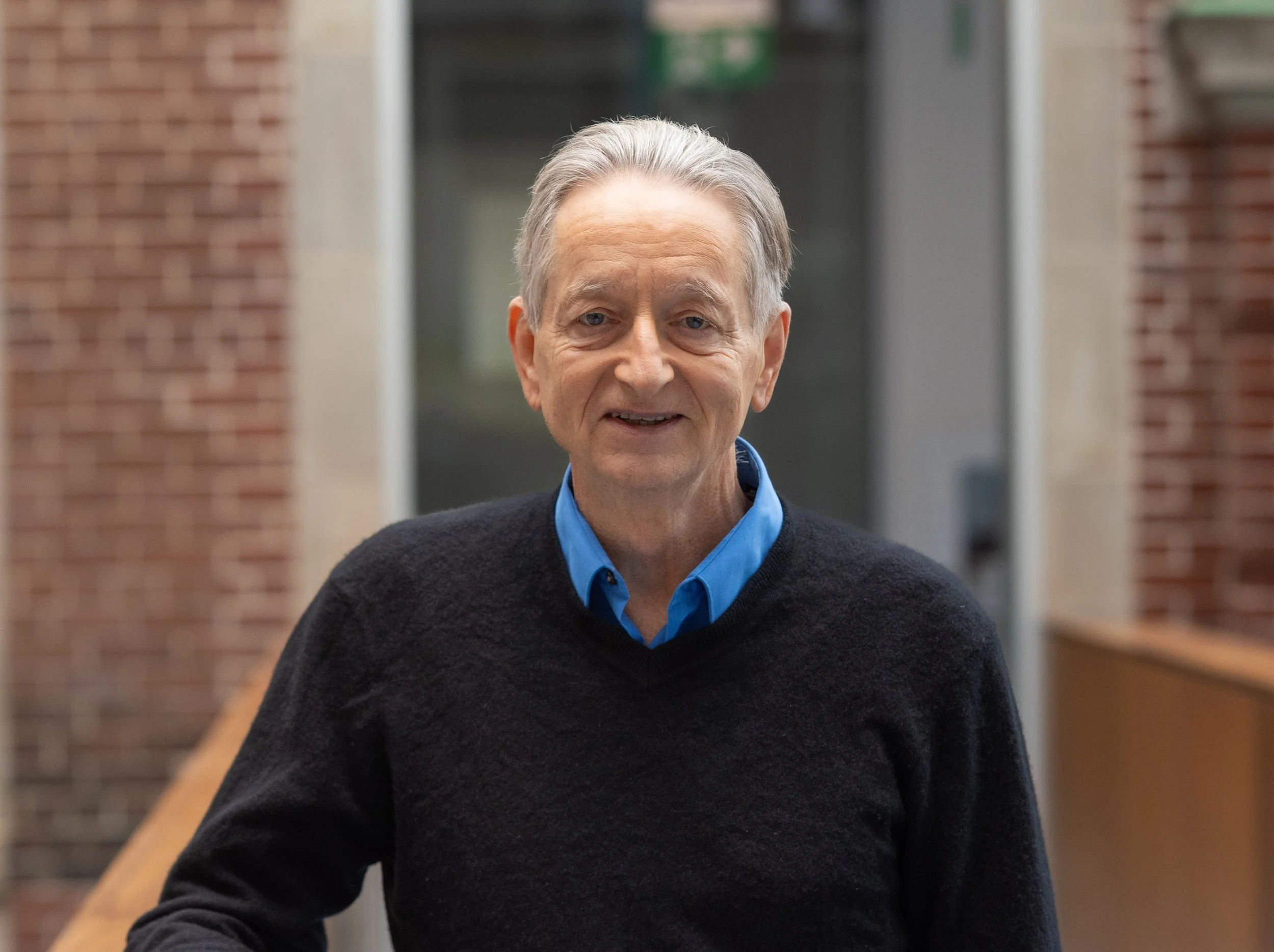
Geoffrey Hinton
Strategic Advisor, Schwartz Reisman Institute for Technology and Society
University of Toronto
Geoffrey Hinton is a pioneering computer scientist whose work laid the foundations for modern artificial intelligence. He earned his PhD in artificial intelligence from the University of Edinburgh and later became a University Professor Emeritus in the Department of Computer Science at the University of Toronto, where his research group produced breakthroughs that helped launch the deep learning revolution in areas such as speech recognition and computer vision.
Hinton was one of the researchers who introduced the backpropagation algorithm and made several foundational contributions to neural networks, including Boltzmann machines, distributed representations, word embeddings, and deep learning architectures. In 2013, Google acquired DNNresearch, a startup emerging from his University of Toronto lab, after which he served as a Vice President and Engineering Fellow at Google until 2023.
He is one of the most widely cited computer scientists in the world and a fellow of the UK Royal Society, the Royal Society of Canada, the Association for the Advancement of Artificial Intelligence, and a foreign member of both the U.S. National Academy of Engineering and the American Academy of Arts and Sciences.
Hinton’s many honors span the highest recognition in computer science, engineering, and technology. His awards include the David E. Rumelhart Prize, the IJCAI Award for Research Excellence, the Killam Prize for Engineering, the NSERC Herzberg Gold Medal, the IEEE James Clerk Maxwell Gold Medal, the NEC C&C Award, the BBVA Award, the Honda Prize, the ACM A.M. Turing Award, the Princess of Asturias Award, the VinFuture Grand Prize, the Queen Elizabeth Prize in Engineering, and the 2024 Nobel Prize in Physics.

David Lie
Director, Schwartz Reisman Institute for Technology and Society
Department of Electrical & Computer Engineering
David Lie is a world-leading computer security expert who is known for his seminal work that led to modern trusted execution processor architectures. As professor at the Edward S. Rogers Sr. Department of Electrical & Computer Engineering (ECE) at the University of Toronto, with cross-appointments in the Department of Computer Science and Faculty of Law, and a Canada Research Chair in Secure and Reliable Systems, Lie’s research goal is to ensure that the computing infrastructure our societies rely on heavily be secure, reliable, and trustworthy—especially at a crucial time when computer systems increasingly permeate our lives. Lie was an inaugural research lead at the Schwartz Reisman Institute, and is a member of Innovation, Science and Economic Development Canada’s (ISED) Safe and Secure AI Advisory Group. He has worked on a number of interdisciplinary research projects at the intersection of computing, policy, law, and the use, stewardship, and governance of data, including current work on mobile and embedded device security and developing robust, secure, and safe AI systems.
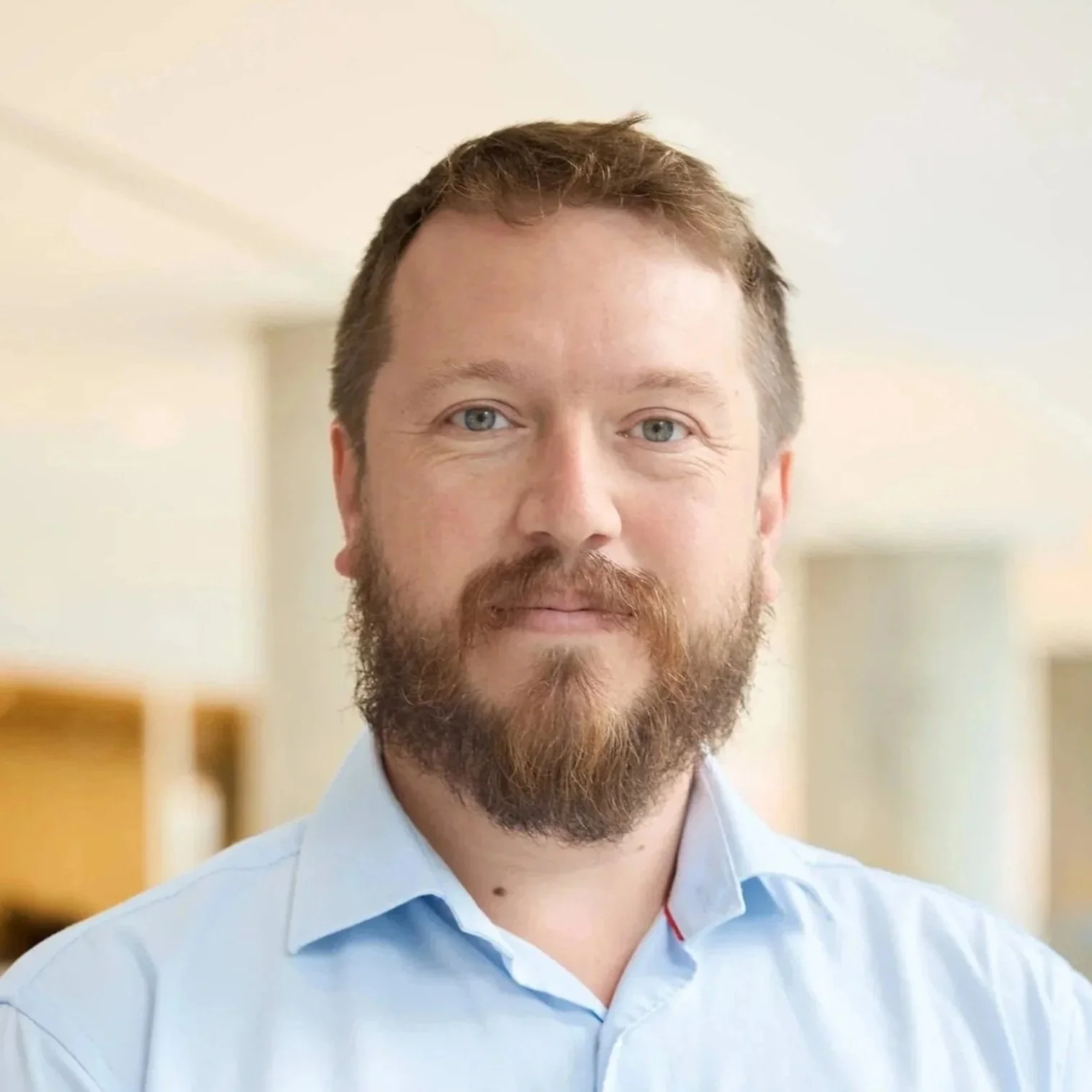
David Duvenaud
Schwartz Reisman Chair in Technology and Society
Department of Computer Science
David Duvenaud is a leading researcher in AI safety and an associate professor in the Department of Computer Science at the University of Toronto. He holds a Canada CIFAR AI Chair and is founding member of the Vector Institute. Duvenaud’s pioneering work in probabilistic deep learning has significantly influenced the field, and his current research focuses on artificial general intelligence governance, evaluation, and mitigating catastrophic risks from future systems. He holds a Schwartz Reisman Chair in Technology and Society (2024–29), and is a past recipient of a Sloan Research Fellowship and Canada Research Chair in Generative Models. Duvenaud is also a member of Innovation, Science and Economic Development Canada’s (ISED) Safe and Secure AI Advisory Group, and recently completed an extended sabbatical on the Alignment Science team at Anthropic.

Roger Grosse
Schwartz Reisman Chair in Technology and Society
Department of Computer Science
Roger Grosse is a renowned expert in AI safety and associate professor in the Department of Computer Science at the University of Toronto, as well as a Canada CIFAR AI Chair and founding member of the Vector Institute. His research applies understandings of deep learning to the safety and alignment of AI systems in order to understand and mitigate the risks posed by them and to determine how they can be safely and ethically integrated for the long-term benefit of humanity. Grosse holds a Schwartz Reisman Chair in Technology and Society (2024–29), a Schmidt Sciences AI2050 Senior Fellow, and is a member of the technical staff on the alignment team at Anthropic, where his work focuses on data training attribution.

Sheila McIlraith
Associate Director and Research Lead, Schwartz Reisman Institute for Technology & Society
Department of Computer Science
Sheila McIlraith is a professor in the University of Toronto’s Department of Computer Science, a Canada CIFAR AI Chair at the Vector Institute, and associate director and research lead at the Schwartz Reisman Institute for Technology and Society. McIlraith is author of over 150 scholarly publications in the areas of knowledge representation, automated reasoning, and machine learning. Her work focuses on AI sequential decision making, broadly construed, through the lens of human-compatible AI. McIlraith is a fellow of the ACM and AAAI, and currently serves as chair of Stanford’s One Hundred Year Study on Artificial Intelligence (AI100) and as a member of the Canadian AI Safety Institute Research Council. McIlraith initiated and co-leads U of T’s Embedded Ethics Education Initiative (E3I), which has been honoured with university and national awards for innovation and impact. McIlraith and her co-authors have been recognized with a number of honours including the 2011 SWSA Ten-Year Award, the ICAPS 2022 Influential Paper Award, and the 2023 IJCAI-JAIR Best Paper Prize. McIlraith has also been recognized with a 2024 CAIAC Lifetime Achievement Award and as a 2025 Schmidt Sciences AI2050 Senior Fellow.

Monique Crichlow
Executive Director, Schwartz Reisman Institute for Technology & Society
University of Toronto
As Executive Director of the Schwartz Reisman Institute for Technology and Society at the University of Toronto, Monique Crichlow oversees strategy, operations, partnerships, and an interdisciplinary team tackling complex problems in the social impacts of advanced technologies like AI. Previously, Crichlow was Director of Strategic Engagement & Partnerships at Indoc Research, an organization dedicated to driving scientific innovation and research excellence, and Director of Strategic Initiatives & Partnerships at Compute Ontario, where she managed supercomputing initiatives to support research. Crichlow's expertise extends to policy development in highly technical domains and extensive knowledge of the value and implications of advanced technologies. Known for her ability to build and lead high-performance teams, scale organizations, and articulate organizational value propositions in policy discussions, Crichlow’s strong sense of justice and dedication to solving complex problems in new ways have earned her invitations from senior leaders to address critical challenges. A champion of financial sustainability and stakeholder engagement, Crichlow's hands-on approach and commitment to operational excellence are at the core of her role in fostering growth and success at SRI.
Founding Donors

“The notion of being associated with an Institute focused on exploring technology and the human experience is exhilarating for us. We’re thrilled that we can supercharge the University of Toronto’s ability to recruit and inspire the best talent in the world.”
— Gerald Schwartz & Heather Reisman
When they heard that the University of Toronto was planning a new centre dedicated to innovation, Gerald Schwartz and Heather Reisman knew they wanted to get involved. The couple sensed this was a transformational initiative and firmly believed it would lead to the creation of life-changing ideas and enterprises.