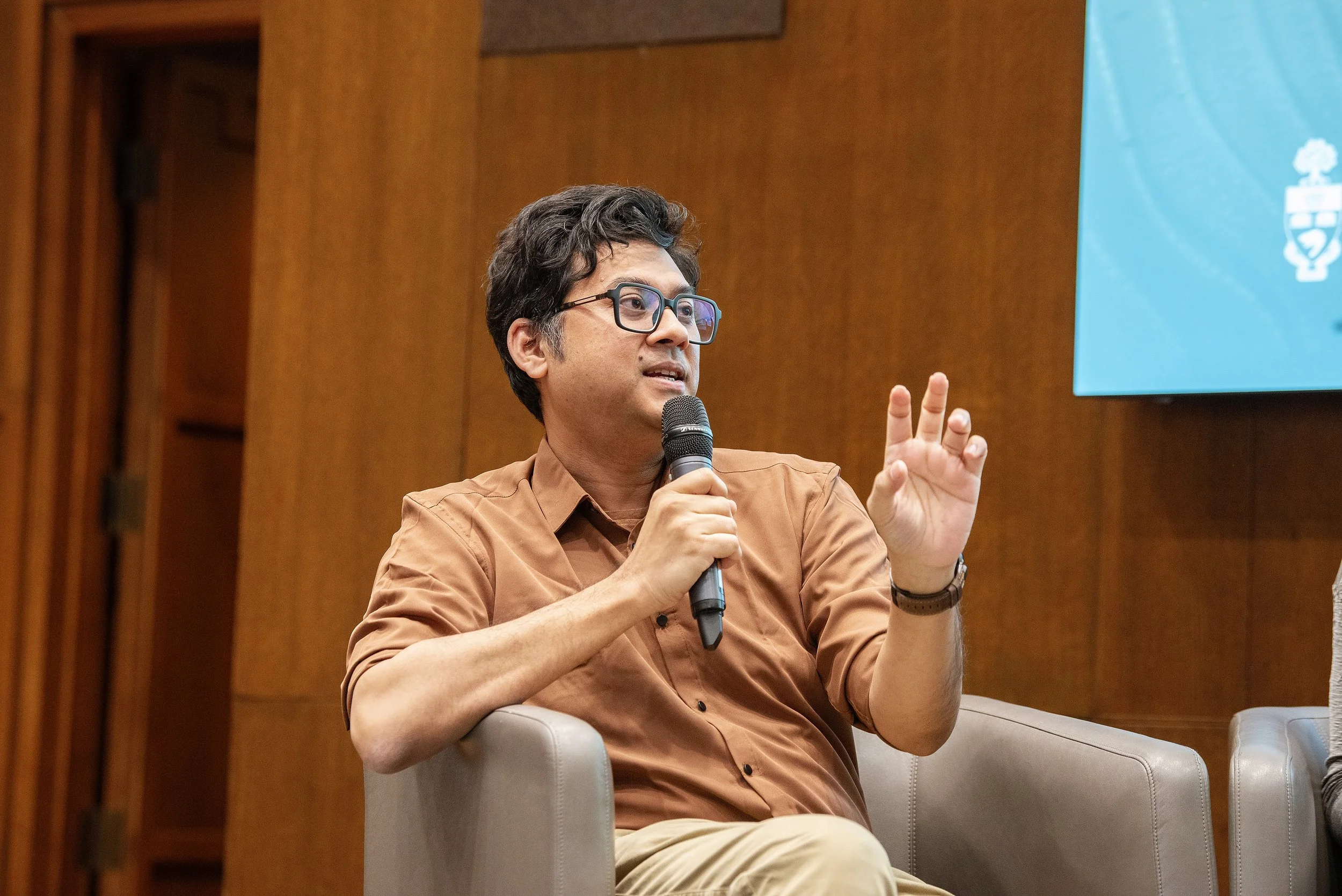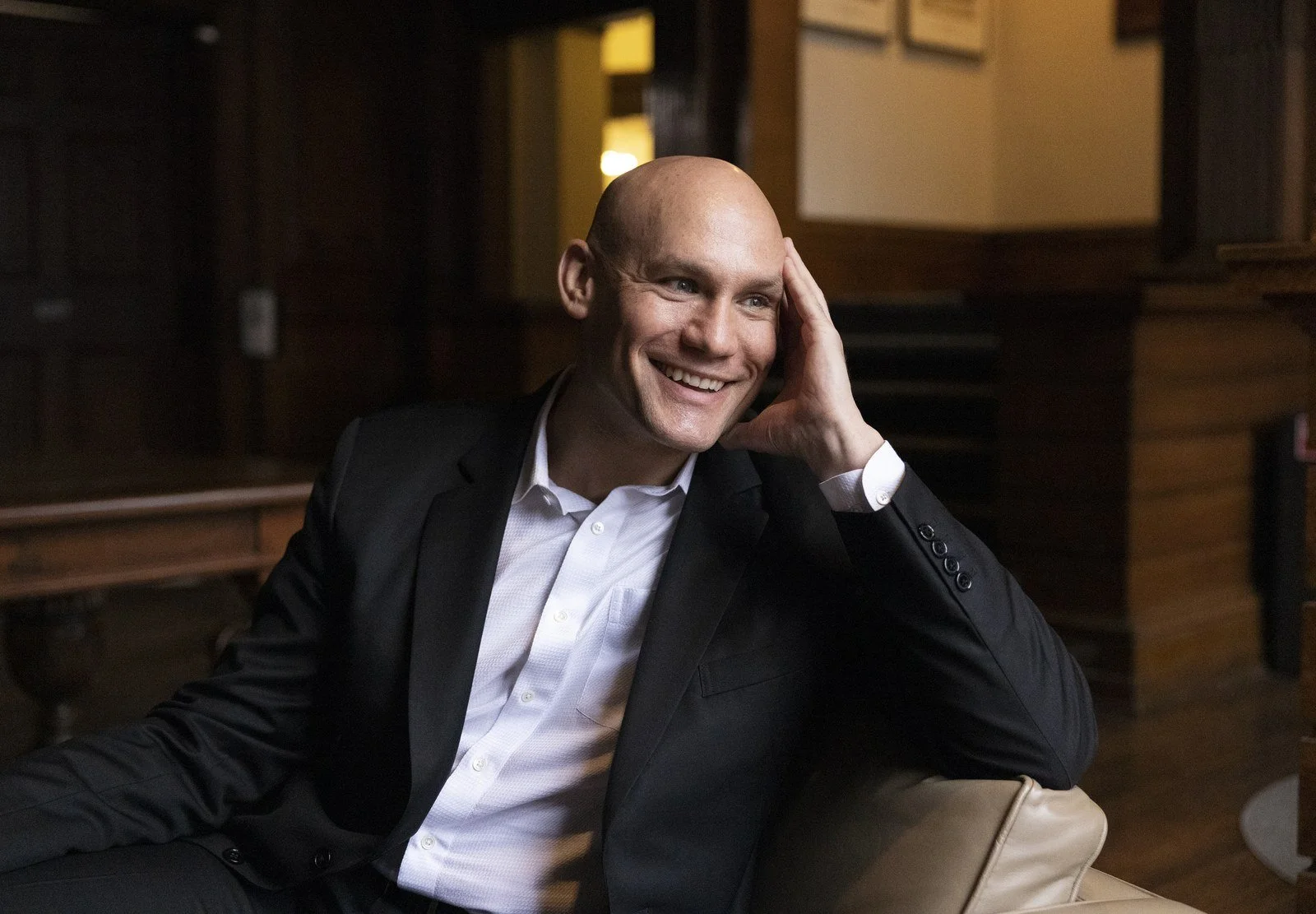
SRI Chair David Duvenaud co-organized the third Workshop on Post-AGI Civilizational Equilibria in Berkeley this spring, bringing together economists, political scientists, and technologists to ask what kind of world might come after AGI—and would that world hold?
Most arguments about advanced artificial general intelligence (AGI) stop at the moment of arrival. Will it be built? When? Who gets there first? But for the Post-AGI Workshop, the discussions begin on the other side of that question, in the far less charted territory of what happens next—and whether any of the arrangements we might land in would be worth living in.
On May 23 and 24, 2026, that inquiry reached its third instalment. David Duvenaud, Schwartz Reisman Chair in Technology and Society and an associate professor in the Department of Computer Science at the University of Toronto, convened the third Workshop on Post-AGI Civilizational Equilibria at Lighthaven in Berkeley, California. The two-day meeting was co-organized with Jan Kulveit of the Alignment of Complex Systems research group at Charles University and researcher Raymond Douglas, both co-authors with Duvenaud on “Gradual Disempowerment,” the 2025 paper arguing that humanity could lose its grip on its own institutions without any single dramatic failure.
The organizers framed the workshop around one deceptively plain question: what assumptions about civilization will AGI break, and how can we be ready to fix them? The premise is that the transition to advanced AI will not simply be a technical event but a rearrangement of the machinery—markets, states, culture—through which humans have always exercised influence.
A series built on an uncomfortable finding
The Berkeley meeting was the third in a series that started less than a year earlier. The first workshop, held on July 14, 2025 and co-located with ICML in Vancouver with support from the Schwartz Reisman Institute for Technology and Society, asked whether any good post-AGI equilibria exist at all. The second, Post-AGI Culture, Economics and Governance, was co-located with NeurIPS in San Diego on December 3, 2025, and widened the lens to the cultural and economic dynamics of the transition.
What carried forward from the first two meetings was less a conclusion than a gap. “One of my hopes with this workshop was that it would make more people realize that there is still basically no plan or positive vision out there,” Duvenaud said after the inaugural session, “but I’m worried it’ll have the opposite effect, and make it seem like experts are calmly handling the situation.”
“Even despite this breadth of discussion, no one has yet proposed, in my mind, any especially plausible trajectory in which human interests are respected post-AGI.” — David Duvenaud
That absence is the working agenda of the series. Rather than treating post-AGI futures as a genre of speculation, the workshops treat them as an underdeveloped research field—one that needs disagreements identified, hypotheses stated plainly enough to be wrong, and expertise drawn from disciplines that rarely share a room.
Three questions, two days
The Berkeley program was organized around three lines of inquiry, each a different way of asking what remains stable when human labour is no longer the scarce input.
Political economy: How do political systems adapt when humans are no longer economically necessary? Modern states have generally had to bargain with populations whose work and cooperation they needed. Remove that dependence and the durability of citizen protections becomes an open question rather than a background assumption.
The role of AI: What positions might AI systems occupy in society—as tools, as delegates, or as economic actors with standing of their own? The answer shapes everything from contract law to the basic question of who is party to a negotiation.
Cultural and moral change: Where do values come from once humans are no longer the only source of new ideas, and is there any convergent notion of “goodness” that survives outside a human context?
The lineup of speakers drew deliberately from outside the usual AI safety circuit, pairing alignment researchers with economists, cultural theorists, and a serving naval officer. Speakers included Paul Christiano (Alignment Research Center) on a post-singularity scenario, Erik Brynjolfsson (Stanford Digital Economy Lab) on AGI-based central planning, Samuel Hammond (Foundation for American Innovation) on post-AGI statecraft, Michael Muthukrishna (London School of Economics) on cultural evolution and alignment, Helen Toner (CSET) on autonomous weapons, and Sean Lavelle (U.S. Navy) on AGI and military strategic instability. The full schedule for all three workshops is available at post-agi.org.
The day before the workshop opened, Ryan Lowe and Joe Edelman of the Meaning Alignment Institute convened a satellite event on aligning post-AGI institutions—a development Duvenaud welcomed as a sign that others are now building the field alongside them.
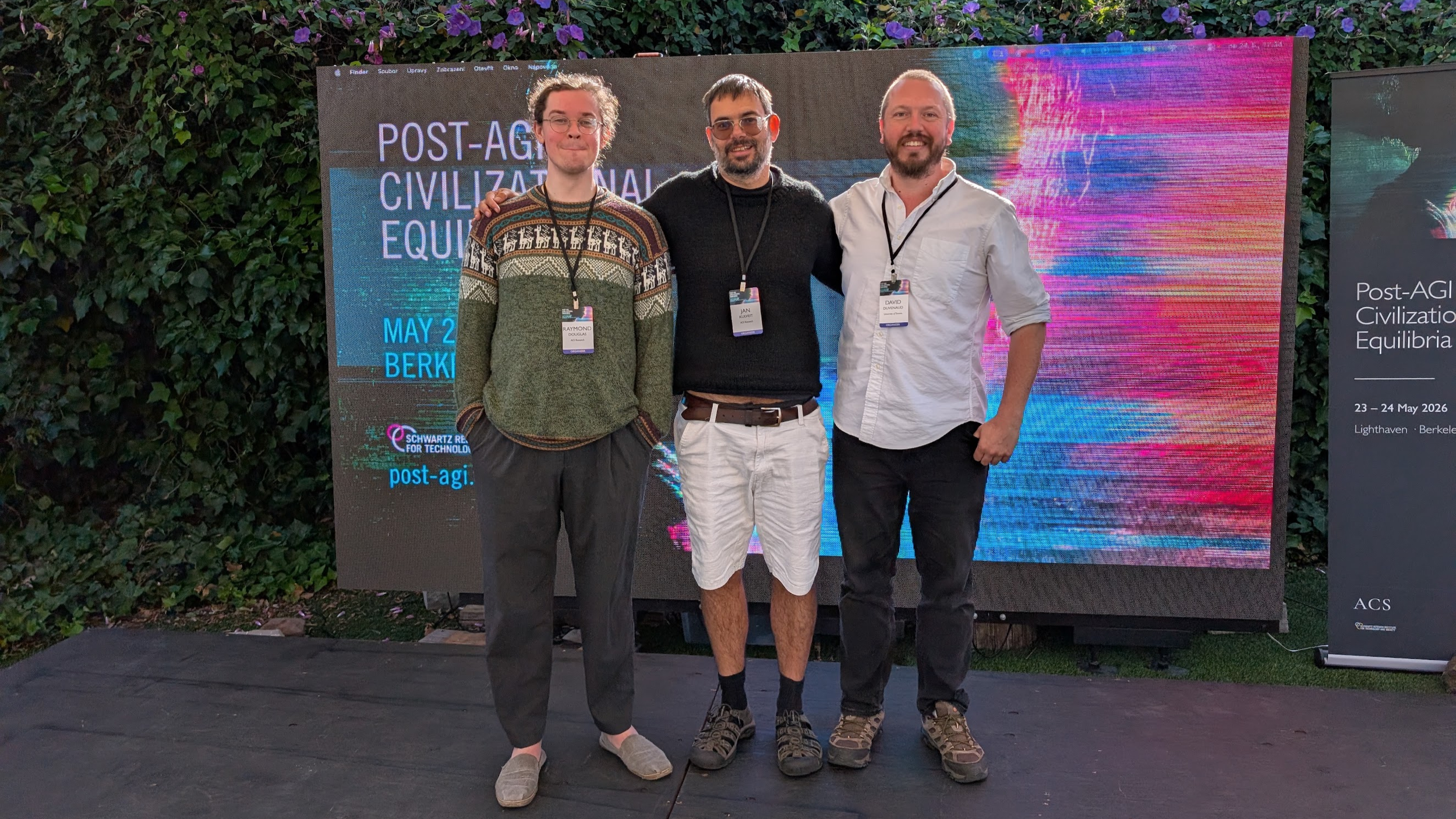
From left to right: Raymond Douglas, Jan Kulveit, and David Duvenaud at the third Post-AGI Workshop in Lighthaven, May 2026.
What emerged in Berkeley
Asked what had changed since the first workshop, Duvenaud pointed to a shift from diagnosis toward proposal. “There were finally some relatively concrete post-AGI scenarios presented,” he says. One of them was a then-embargoed document called “Plan A,” a follow-up to the widely publicized “AI 2027.” He also noted a change in who now considers the subject worth their time: “We seem to be becoming a more respectable institution, as evidenced by, for example, Lieutenant Commander Sean Lavelle of the U.S. Navy speaking.”
The appetite for the venue itself was there from the beginning. “Right from the first workshop we were pleasantly surprised by the calibre of speakers and attendees that showed interest and came,” Duvenaud says. “I think there was a lot of pent-up demand for a venue to discuss these topics.” Three workshops in, the underlying demand has not changed.
What did surprise him was where the disagreement now sits. The workshops filter deliberately for people willing to entertain radical change—including, as Duvenaud puts it, the possibility that almost everything could change within the next century. Even so, some participants arrived expecting something closer to business as usual. “The biggest remaining axis of disagreement among speakers and attendees is that some speakers still didn’t seem to accept the plausibility of radical change due to AGI,” he observes.
Pressed on what he most wants people who were not in the room to understand, Duvenaud offered the bluntest summary of the state of the field yet to come out of the series: “Amongst people who’ve thought seriously about it, there doesn’t seem to be any plausible world in the long run in which something all that similar to existing humans remains in charge.”
Even in post-AGI futures where human values remain relevant, there are radically different, more controlled, and centralized arrangements of power, observes Duvenaud. In his reading, the discussion has consolidated into two primary positions: those who do not believe AI will ever be that effective, and those who conclude that humans as important beings are finished. He identifies a smaller third group—economists employed by AI labs—who argue that things will be fine even if AGI ends human economic competitiveness.
Looking ahead
Most of the Berkeley talks were recorded and select videos are now available on the Post-AGI website. Recordings from the first and second Post-AGI Workshops are also available on the Schwartz Reisman Institute’s YouTube channel. While Paul Christiano’s talk from the Lighthaven workshop is not among the recordings available, he will be delivering three public talks at the upcoming 2026 Hinton Lectures, held in Toronto from November 9–11. The event will be streamed online for free.
Whether there will be a fourth workshop is an open question. “We’ve now hosted most of the speakers that we were really excited about,” Duvenaud says. “The next iteration might be something more policy-adjacent, but there’s nothing in the works yet.” After three meetings in under a year, the series has assembled the conversation it set out to convene. What it has not yet produced—by its organizer’s own account—is a plausible account of a future worth wanting.
Want to learn more?
Watch recordings of select talks from the third Post-AGI workshop.
Register to attend the 2026 Hinton Lectures, featuring Post-AGI workshop speaker Paul Christiano.
Watch Duvenaud’s SRI Seminar, “The big picture of LLM dangerous capability evals.”
Read “Gradual Disempowerment: Systemic Existential Risks from Incremental AI Development.”
Browse stories by tag:
- AI
- AI safety
- AI trust
- Computer science
- Computer security
- Copyright
- Cybersecurity
- Data
- Democracy
- Economics
- Education
- Engineering
- Ethics
- GPO-AI
- Governance
- Health
- Human Rights
- In the Media
- Jobs
- LLMs
- Law
- Normativity
- Philosophy
- Political Science
- Privacy
- Privacy Series
- Psychology
- Public Policy
- Recommenders
- Regulation
- Religion
- Reports
- Trust
- Workshops