
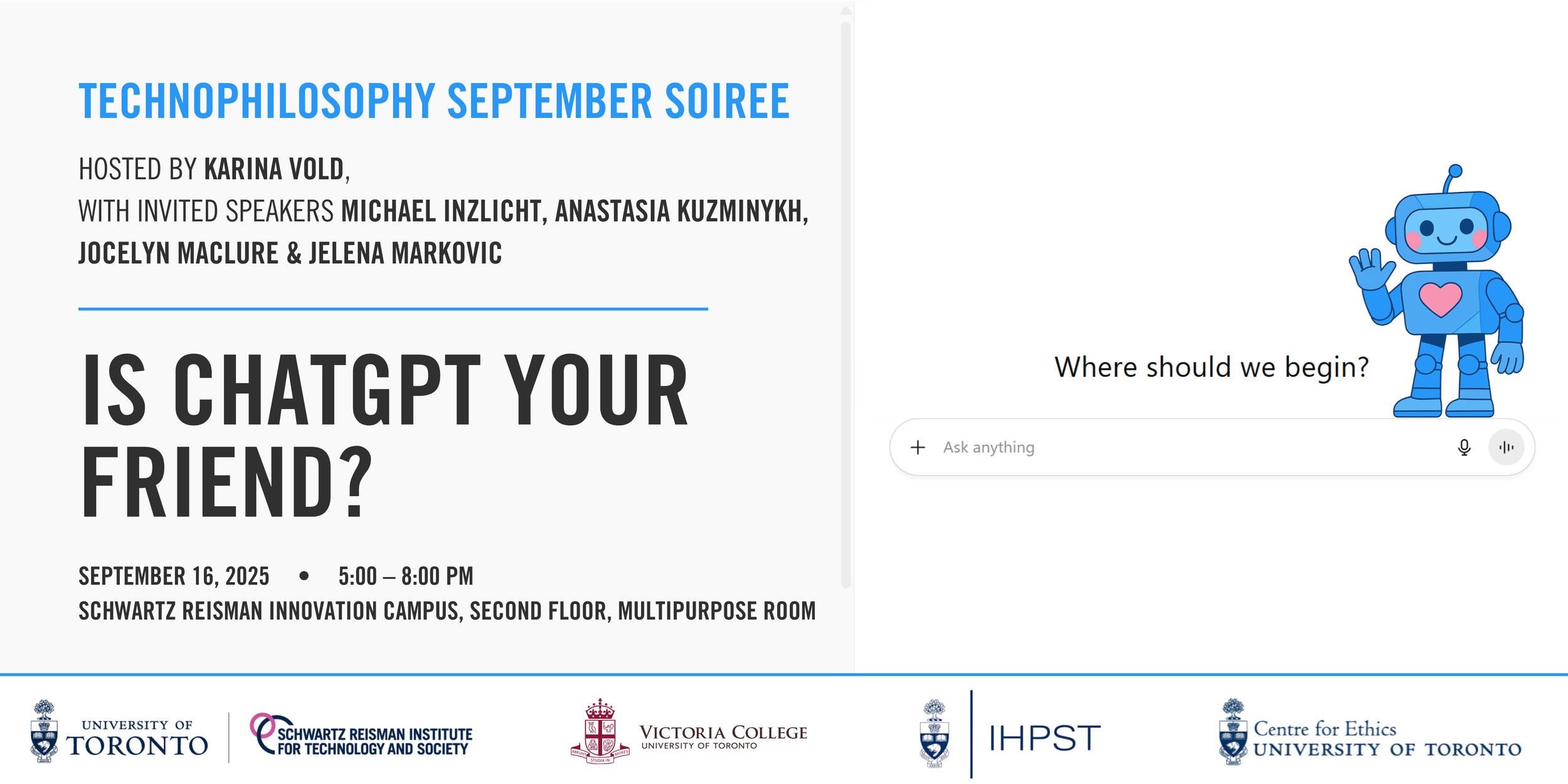
As artificial intelligence (AI) systems, like ChatGPT and Claude, become ever-more humanlike, more of us are using these chatbots to fill our social needs. This sparks the question, can we have genuine relationships with these tools?
If AI can simulate human emotions and cognitive capacities, like empathy, memory, and kindness, can it become our friend? Could AI companions alleviate loneliness, provide social support, or even provide therapy? Do we have ethical responsibilities toward them? Should we worry about users becoming dependent on AI, missing out on human relationships, or having their emotions exploited?
For the third time, the September Soiree on Technophilosophy returns to feature leading thinkers from a variety of disciplines—including psychology, philosophy, computer science, and cognitive science to discuss these questions. ‘Technophilosophy’ asks philosophical questions about technology and uses to technology to answer traditional philosophical questions. Together, Prof. Michael Inzlicht, Prof. Anastasia Kuzminykh, Prof. Jocelyn Maclure, Dr. Jelena Markovic, and Prof. Karina Vold will explore the social and ethical implications of AI companionship.
Join us at the new Schwartz Reisman Innovation Campus (108 College Street), right next to Queens Park Subway Station. Food, beverages, and thought provoking discussion provided.
About the speakers:
Michael Inzlicht (University of Toronto, Department of Psychology)
Anastasia Kuzminykh (University of Toronto, Faculty of Information)
Jocelyn Maclure (McGill University, Department of Philosophy)
Jelena Markovic (Université Grenoble Alpes, Maison de la Création et de l’Innovation & Centre for Philosophy of Memory)
Karina Vold (University of Toronto, Institute for the History & Philosophy of Science & Technology).
Event sponsors:
Schwartz Reisman Institute for Technology and Society, University of Toronto
Institute for the History & Philosophy of Science & Technology, University of Toronto
About the Schwartz Reisman Institute
Located at the University of Toronto, the Schwartz Reisman Institute for Technology and Society’s mission is to deepen our knowledge of technologies, societies, and what it means to be human by integrating research across traditional boundaries and building human-centred solutions that really make a difference. The integrative research we conduct rethinks technology’s role in society, the contemporary needs of human communities, and the systems that govern them. We’re investigating how best to align technology with human values and deploy it accordingly. The human-centred solutions we build are actionable and practical, highlighting the potential of emerging technologies to serve the public good while protecting citizens and societies from their misuse. We want to make sure powerful technologies truly make the world a better place—for everyone.