
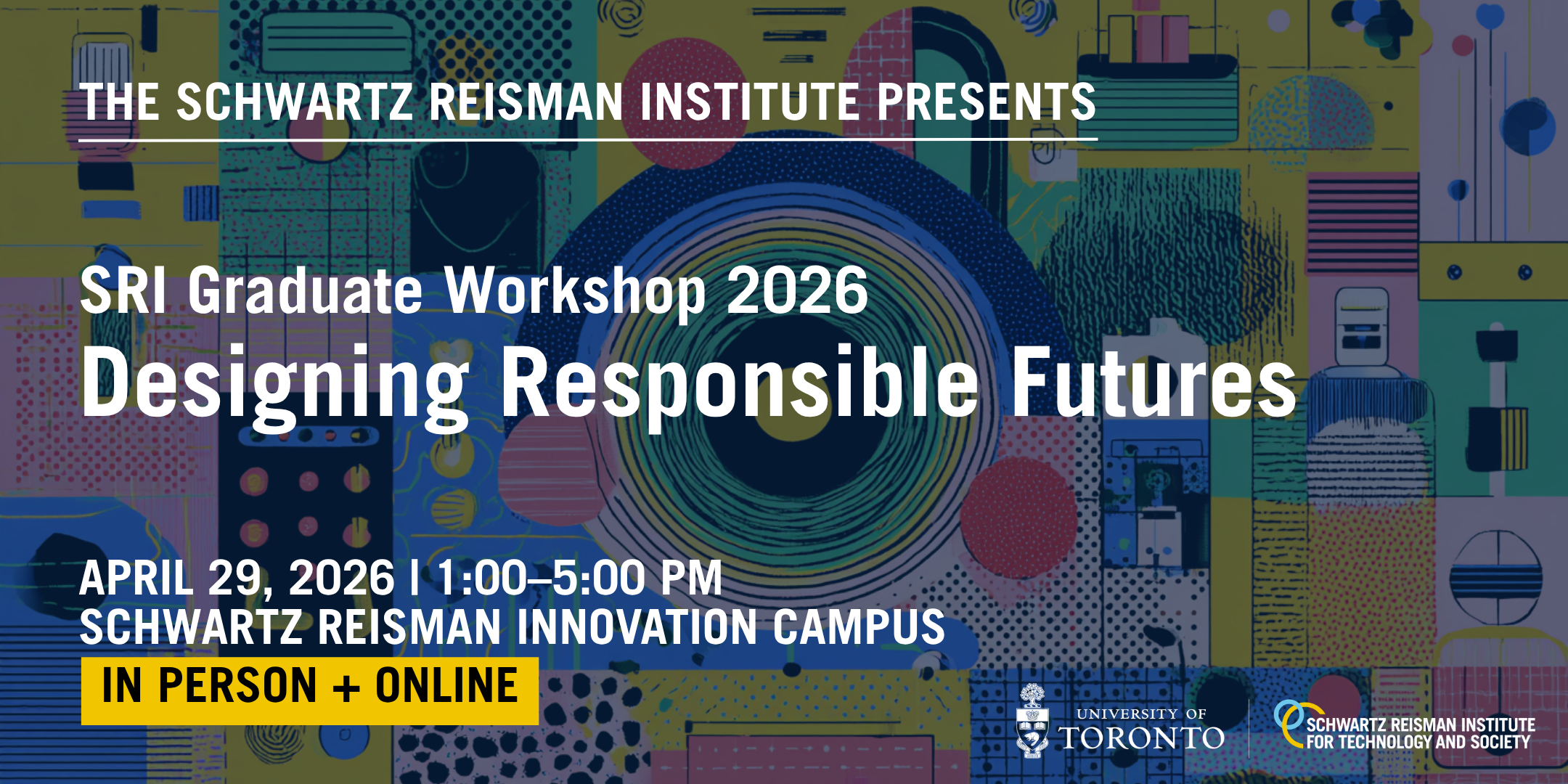
Organized by the Schwartz Reisman Institute for Technology and Society’s 2025–26 cohort of graduate fellows, this workshop explores how increasingly capable AI systems reshape responsibility, authority, and governance across technical, institutional, and societal domains.
Bringing together researchers, practitioners, and emerging scholars, the program moves from current approaches to trustworthy AI, to questions of expertise and governance, to long-term futures shaped by increasingly autonomous systems.
Agenda
1:00 – 1:10 PM: Opening Welcome
1:10 – 2:40 PM: Session 1: Responsible Development: Building Trustworthy AI Systems
2:40 – 3:10 PM: Break and Poster Session
3:10 – 4:40 PM: Session 2: Governing Intelligence: Expertise, Power, and AI Futures
4:40 – 4:45 PM: Closing Reflections
4:45 – 5:00 PM: Reception and Poster Session
Venue and registration
Schwartz Reisman Innovation Campus, Collaborative Learning Space (W240), Second Floor, 108 College. St., Toronto, ON, M5G 0C6
Online participation via Zoom (link sent to registrants).
Registration is free to attend. In-person registration is limited.
Sessions
Responsible Development: Building Trustworthy AI Systems
Speakers: Rafael Grohmann, University of Toronto; Shingai Manjengwa; Mila – Quebec Artificial Intelligence Institute
Moderators: Mai Ali, University of Toronto; Benjamin Cookson, University of Toronto
As AI systems are deployed in high-stakes domains, ensuring their safety, fairness, privacy, and accountability has become a central challenge. This session examines the technical and institutional foundations of responsible AI development, exploring how current methods aim to mitigate risk, protect user privacy, and promote equitable outcomes. Speakers will discuss state-of-the-art approaches to trustworthy machine learning, including reinforcement learning from human feedback, differential privacy, and fairness-aware training techniques, alongside emerging threats such as privacy leakage, adversarial manipulation, and system misuse. The session also considers how responsible development is implemented in practice across healthcare, industry, and public-facing systems.
Governing Intelligence: Expertise, Power, and AI Futures
Speakers: Zhijing Jin (virtual), University of Toronto; Peter Lewis, Ontario Tech University; Vanessa Richter (virtual), University of Bremen
Moderators: Kaushar Mahetaji, University of Toronto, Lunjun Zhang, University of Toronto
Who governs AI systems, and whose expertise shapes their development, deployment, and future trajectories? As AI systems become increasingly autonomous and agentic, new questions emerge about governance, societal power, and the futures we are building. This session explores the relationship between technical alignment, institutional oversight, and social authority in AI ecosystems, examining how intelligent systems are guided, monitored, and governed in practice. Speakers will discuss recent technical work on aligning advanced AI systems with human values, the role of expertise and trust in automated decision-making environments, and the institutional structures that shape AI governance. The session will also examine competing visions of AI futures and their implications for governance, including emergent incentives in agentic systems, scenarios involving runaway AI, and the possibility of gradual human disempowerment in highly automated environments. Particular attention will be given to how industry, media, and policymakers construct narratives about AI futures—and how these imaginaries shape governance approaches today. Together, the discussion connects near-term governance challenges with long-term societal implications, addressing broader questions of legitimacy, accountability, and power in governing intelligent systems.
Speakers

Rafael Grohmann
Assistant Professor, Department of Arts, Culture and Media, University of Toronto
Faculty Affiliate, Schwartz Reisman Institute for Technology and Society
Rafael Grohmann is an Assistant Professor of Media Studies (Critical Platform Studies) at the University of Toronto. He is research associate at the University of Oxford, founding editor of Platforms & Society journal and leader of DigiLabour initiative. His research focuses on digital labour, AI and work, AI in the cultural sector, workers’ organizing, platform cooperativism and digital solidarity economy, especially in Latin America. He is also a Faculty Affiliate at the Schwartz Reisman Institute for Technology and Society, a Senior Fellow at Massey College and an Advisory Board Member at the Centre for Culture and Technology. His previous affiliations include Weizenbaum Institute and University of Sao Paulo. Rafael published in academic outlets such as Big Data & Society, New Media & Society, International Journal of Communication, Information, Communication & Society, and Social Media + Society. He is an editorial board member of Communication, Culture and Critique and Big Data & Society.

Zhijing Jin
Assistant Professor, Department of Computer Science, University of Toronto
Canada CIFAR AI Chair, Vector Institute
Faculty Affiliate, Schwartz Reisman Institute for Technology and Society
Zhijing Jin is an incoming assistant professor at the University of Toronto and a research scientist at the Max Planck Institute, with additional affiliations as a CIFAR AI Chair and faculty member at the Vector Institute, ELLIS advisor, and faculty affiliate at the Schwartz Reisman Institute. Her work sits at the intersection of artificial intelligence, causal reasoning, and responsible AI, with a focus on advancing both the technical foundations of large language models and their alignment with societal values. Her research spans large language models, causal inference, multi-agent systems, and AI safety, alongside complementary work in interpretability and robustness. Jin is an active contributor to the international AI research community, serving in leadership and mentorship roles across major conferences and initiatives, and her work has been recognized with multiple awards and fellowships. Her research has also been featured in outlets including WIRED, MIT News, and Chip magazine.

Peter Lewis
Associate Professor, Faculty of Business and Information Technology, Ontario Tech University
Canada Research Chair in Trustworthy Artificial Intelligence
Peter Lewis holds a Canada Research Chair in Trustworthy Artificial Intelligence at Ontario Tech University, Canada, where he is an Associate Professor and Director of the Trustworthy AI Lab. Lewis’s research advances both foundational and applied aspects of AI and draws on extensive experience applying AI commercially and in the non-profit sector. He is interested in where AI meets society, and how to help that relationship work well. His current research is concerned with challenges of trust, bias, and accessibility in AI, as well as how to create more socially intelligent and reflective AI systems, such that they work well as part of society, explicitly taking into account human factors such as norms, values, social action, and trust. He is Associate Editor of IEEE Transactions on Technology & Society, IEEE Technology & Society Magazine and ACM Transactions on Autonomous and Adaptive Systems, a board member of the International Society for Artificial Life with responsibility for Social Impact, and Co-Chair of the Steering Committee for the IEEE International Conference on Autonomic and Self-organizing Systems. He has a PhD in Computer Science from the University of Birmingham, UK.

Shingai Manjengwa
Senior Director, Education and Development, Talent & Ecosystem, Mila – Quebec Artificial Intelligence Institute
Shingai Manjengwa is a leading voice in AI education, adoption, and governance. She is Head of AI Education and Development at the Mila Quebec AI Institute, one of the world's foremost AI research centres, where she designs and delivers programs that build AI fluency across government, industry, and underserved communities. She is also the Founder and CEO of Fireside Analytics Inc., an AI education and consulting firm whose programs have reached over 500,000 learners globally. Her clients span IBM, the Government of Canada, and international institutions. Shingai is the former Director of Technical Education at the Vector Institute for AI and she is a beloved children's book author. A sought-after speaker, she serves on several advisory boards and councils focused on AI safety, productivity, and governance.

Vanessa Richter
Postdoctoral Research, Center for Media, Communication and Information Research, University of Bremen
Vanessa Richter is a postdoctoral researcher at the Platform Governance, Media and Technology Lab at the Centre for Media, Communication, and Information Research (ZeMKI) at the University of Bremen. Her research focuses on imaginaries around technology such as social media platforms, AI systems, and digital health technology.
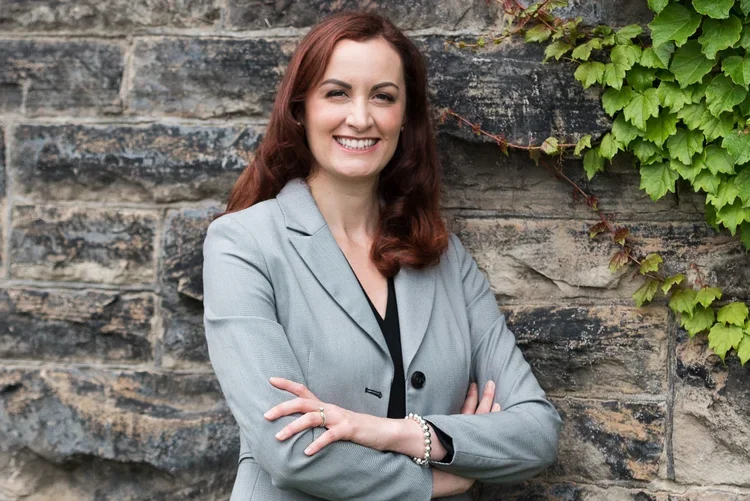
Laura Rosella
Professor, Dalla Lana School of Public Health, University of Toronto
Canada Research Chair in Population Health Transformation and Analytics
Faculty Affiliate, Schwartz Reisman Institute for Technology and Society
Education Lead, U of T Temerty Centre for Artificial Intelligence Research and Education in Medicine (TCAIREM)
Laura C. Rosella is an epidemiologist and professor in the Dalla Lana School of Public Health at the University of Toronto, where she holds a Canada Research Chair in Population Health Analytics and leads the Population Health Analytics Lab. Her research interests include population health, population-based risk tools to support public health planning and public health policy. Rosella holds the Inaugural Stephen Family Research Chair in Community Health at the Institute for Better Health, Trillium Health Partners and has scientific appointments at Vector and ICES. She leads training at the Temerty Centre for Artificial Intelligence Research and Education in Medicine and the Data Sciences Institute, and is the director of AI4PH, which is focused on building capacity in AI and big data skills for transformative change in addressing population and public health challenges, and understanding how these tools impact health equity.
Organizing committee
Mai Ali, Department of Electrical & Computer Engineering, University of Toronto
Benjamin Cookson, Department of Computer Science, University of Toronto
Cong Yu (Emmy) Fang, Department of Computer Science, University of Toronto
Matthew Iantorno, Faculty of Information, University of Toronto
Rachel Katz, Institute for the History and Philosophy of Science & Technology, University of Toronto
Kexin (Cassie) Li, Department of Electrical & Computer Engineering, University of Toronto
Nanyu Luo, Ontario Institute for Studies in Education, University of Toronto
Kaushar Mahetaji, Faculty of Information, University of Toronto
David-Dan Nguyen, Institute of Health Policy, Management & Evaluation, University of Toronto
Darsana Vijay, Faculty of Information, University of Toronto
Lunjun Zhang, Department of Computer Science, University of Toronto
About the Schwartz Reisman Institute
Located at the University of Toronto, the Schwartz Reisman Institute for Technology and Society’s mission is to deepen our knowledge of technologies, societies, and what it means to be human by integrating research across traditional boundaries and building human-centred solutions that really make a difference. The integrative research we conduct rethinks technology’s role in society, the contemporary needs of human communities, and the systems that govern them. We’re investigating how best to align technology with human values and deploy it accordingly. The human-centred solutions we build are actionable and practical, highlighting the potential of emerging technologies to serve the public good while protecting citizens and societies from their misuse. We want to make sure powerful technologies truly make the world a better place—for everyone.