
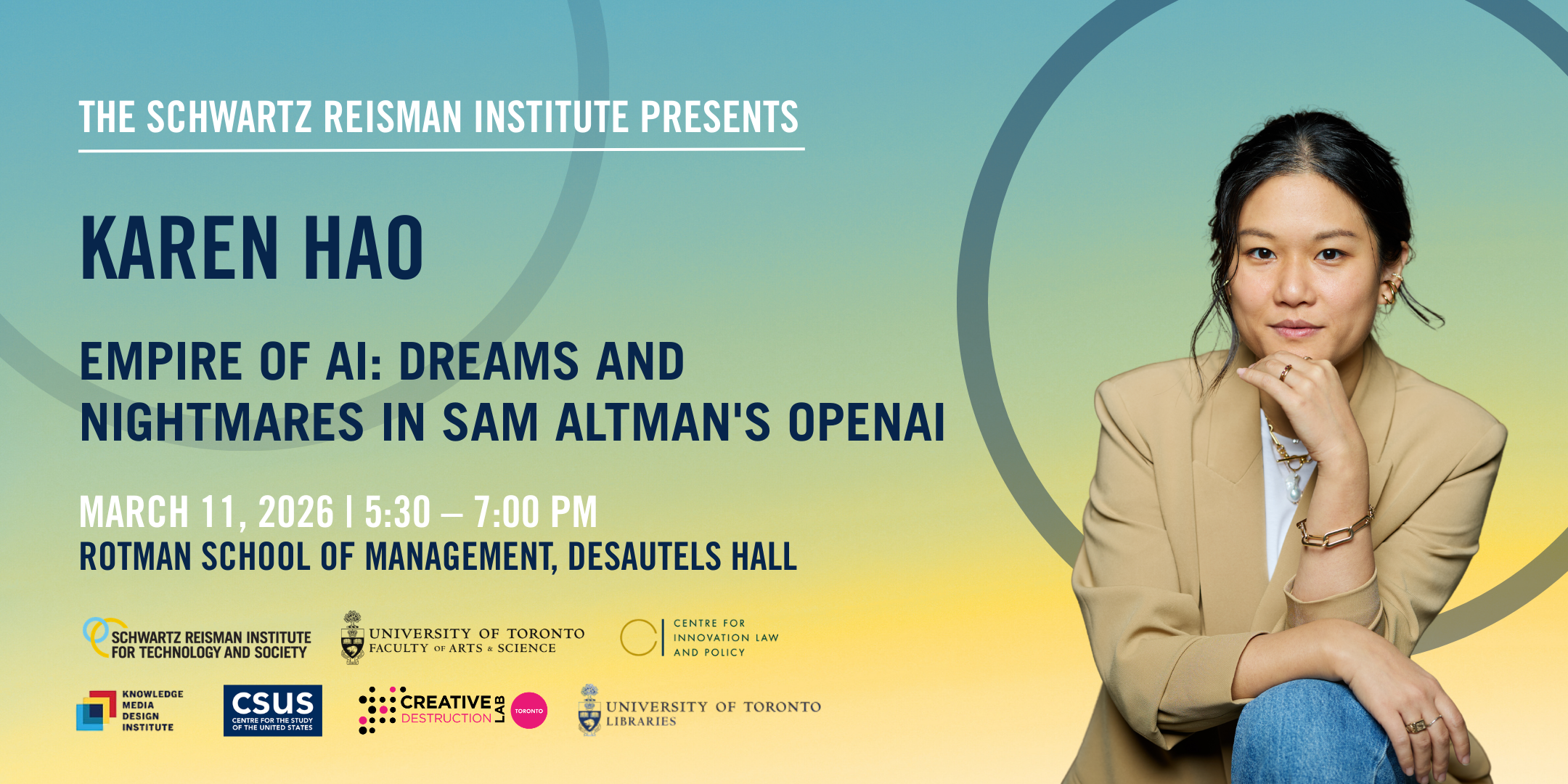
Join us for an in-person conversation with Karen Hao, award-winning author of Empire of AI, on power, ethics, and AI’s global impact.
On March 11, 2026, the Schwartz Reisman Institute for Technology and Society will host an in-person conversation with award-winning journalist and former MIT Technology Review senior editor Karen Hao, author of the 2025 New York Times bestseller, Empire of AI: Dreams and Nightmares in Sam Altman’s OpenAI. With AI governance, labor disruption, and geopolitical power struggles at the forefront of global conversations, this event offers a timely opportunity to engage with Hao’s investigative reporting on the unchecked development of AI combined with the rise of a few dominant tech firms.
Join us for this in-person event as Hao draws on her global reporting and insider access to discuss the implications of AI’s rapid deployment, the erosion of democratic norms, and the need to rethink how we design, govern, and distribute AI systems to support ongoing policy and public interest efforts aimed at ensuring AI benefits society broadly.
Moderator: Nathalie A. Smuha, Faculty of Law, University of Toronto
Venue
Rotman School of Management, Desautels Hall (second floor)
105 St George St, Toronto, ON M5S 3E6
Please note, this is an in-person only event.
Date and time
March 11, 2026 | 5:30 – 7:00 PM ET
4:30 – 5:30 PM | Registration opens
5:30 – 6:15 PM | Keynote: Karen Hao
6:15 – 7:00 PM | Moderated Q&A with Karen Hao and Nathalie A. Smuha
7:00 – 7:30 PM | Book signing (copies of Empire of AI will be available for purchase at the event)
Sponsors
This event is made possible through the generous support of the following partners:
About Karen Hao
Karen Hao is a Silicon Valley engineer–turned–award-winning journalist and one of the foremost voices examining the global impact of artificial intelligence. She is the author of Empire of AI: Dreams and Nightmares in Sam Altman’s OpenAI (2025), an instant New York Times bestseller and a deeply reported investigation into the power, politics, and consequences shaping the AI industry. Named one of TIME’s 100 Most Influential People in AI, Hao has been praised for fundamentally shaping public understanding of the AI revolution. She writes for The Atlantic, leads the Pulitzer Center’s AI Spotlight Series, and was formerly a reporter at The Wall Street Journal and senior editor for AI at MIT Technology Review.
About Nathalie Smuha
Nathalie A. Smuha is an assistant professor in the Faculty of Law at the University of Toronto and a faculty affiliate at the Schwartz Reisman Institute for Technology and Society. Her work focuses on the intersection of law, philosophy and technology, with particular attention to AI’s impact on human rights, democracy and the rule of law. She is the author of Algorithmic Rule By Law: How Algorithmic Regulation in the Public Sector Erodes the Rule of Law, and the editor of The Cambridge Handbook of the Law, Ethics and Policy of Artificial Intelligence, both published with Cambridge University Press in 2025. Besides her academic activities, Professor Smuha regularly advises governments and international organizations on AI policy. Prior to her academic turn, she worked at the European Commission, where she contributed to Europe’s Ethics Guidelines for Trustworthy AI. She was also a scientific expert at the Council of Europe’s Committee on AI, which drafted the first international treaty on Artificial Intelligence.
About the Schwartz Reisman Institute
Located at the University of Toronto, the Schwartz Reisman Institute for Technology and Society’s mission is to deepen our knowledge of technologies, societies, and what it means to be human by integrating research across traditional boundaries and building human-centred solutions that really make a difference. The integrative research we conduct rethinks technology’s role in society, the contemporary needs of human communities, and the systems that govern them. We’re investigating how best to align technology with human values and deploy it accordingly. The human-centred solutions we build are actionable and practical, highlighting the potential of emerging technologies to serve the public good while protecting citizens and societies from their misuse. We want to make sure powerful technologies truly make the world a better place—for everyone.