
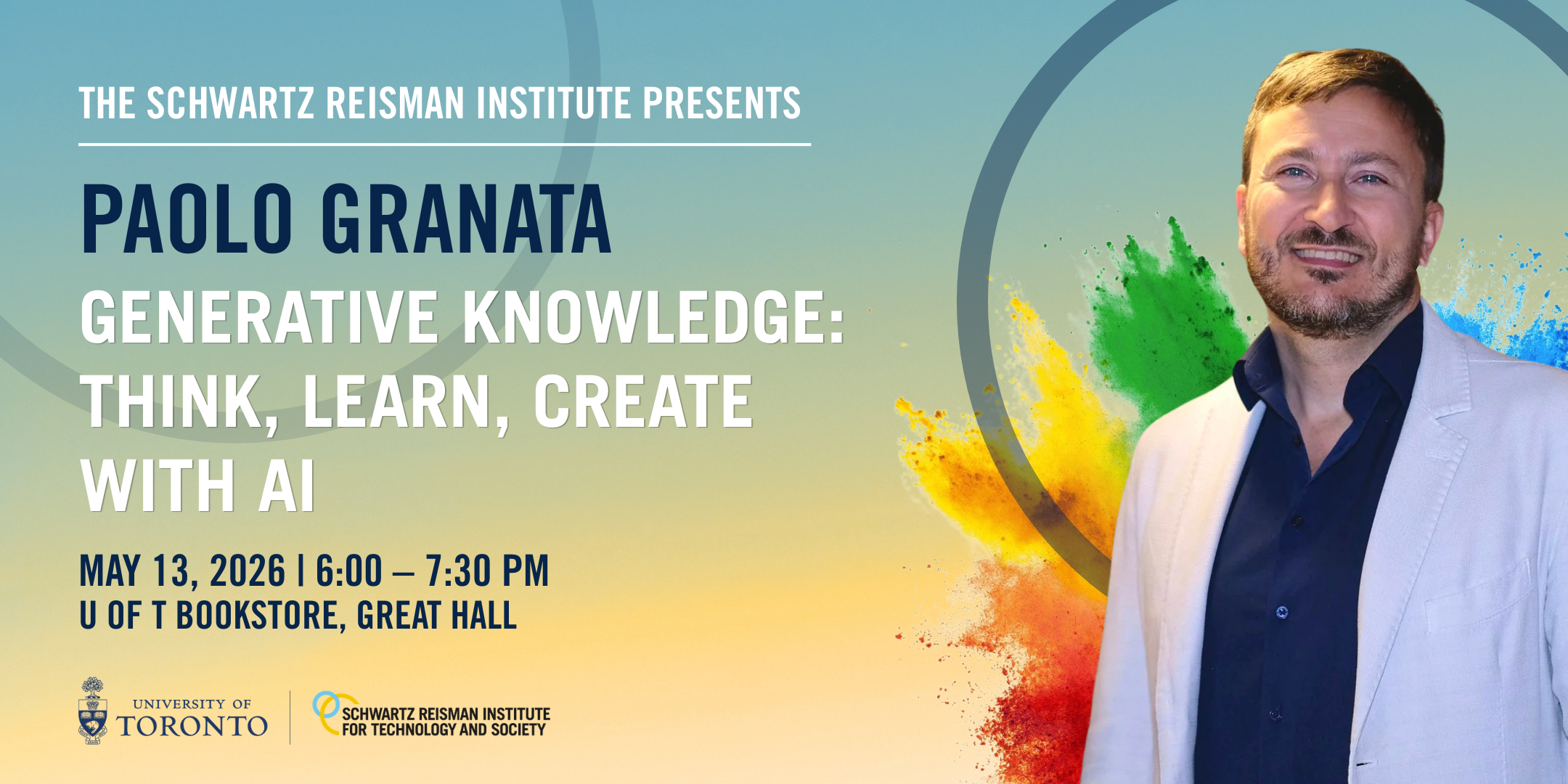
Join us for an in-person conversation with Paolo Granata to discuss his book, "Generative Knowledge: Think, Learn, Create with AI".
On May 13, 2026, the Schwartz Reisman Institute for Technology and Society will host an in-person dialogue led by SRI Faculty Affiliate and associate professor of book and media studies at the University of Toronto, Paolo Granata. In this book talk, Granata introduces the core ideas of his new book, Generative Knowledge: Think, Learn, Create with AI.
Venue:
University of Toronto Bookstore Great Hall (Third floor)
Entrance: 214 College St, Toronto, ON M5T 3A1
As artificial intelligence becomes deeply embedded in research, education, and cultural life, fundamental questions about knowledge are coming into focus: How is knowledge created, validated, and shared in an AI-mediated world? What happens when machines are not only tools for efficiency, but active participants in intellectual work?
Rather than framing AI as a shortcut or a threat, Granata invites us to understand it as an epistemic technology: a medium that reshapes how thinking, learning, research, and creativity unfold.
Drawing on media theory, epistemology, semiotics, and the philosophy of technology, Granata argues that knowledge is not something we simply discover, but something we actively make. He proposes “generative knowledge” as a framework for understanding learning and creativity as iterative, socially embedded, and tool-mediated processes—and introduces the concept of epistemic wellness as a guide for navigating an increasingly automated knowledge economy.
Following a brief presentation, Granata will convene a panel of scholars and practitioners for a wide-ranging discussion on the themes of the book, including:
AI and intellectual creativity beyond the arts
Expertise, collaboration, and collective intelligence in the age of generative tools
Pedagogy, agency, and inquiry in AI-enabled learning environments
The shifting role of public and cultural institutions—from content delivery to context-building
The evening will conclude with an audience Q&A, inviting participants into a shared inquiry about how we can think, learn, and create thoughtfully with AI—without losing sight of judgment, reflection, and meaning.
Speakers
Matt Ratto is Associate Dean, Research and a full Professor in the Faculty of Information at the University of Toronto. Dr. Ratto is also a faculty affiliate with the Climate Positive Energy Institute (CPE), the Schwartz Reisman Institute for Technology and Society (SRI) and an SDG Fellow with the Sustainable Development Goals Institute (SDGs@UofT). He was awarded the Ontario Minister of College and Universities’ Award of Excellence in 2020, and has received two Canada Grand Challenge grants, Stars in Global health and Transition to Scale for his work on 3D printed prosthetics. He was the Bell Canada Usability Labs Chair in Human-Computer Interaction from 2018-2023 and the inaugural Director of the Bachelor’s of Information degree program. His research explores the social production of knowledge in the context of emerging digital technologies and leverages critical theories and perspectives from the humanities and social sciences to develop novel insights and design paradigms. He is most known for his conceptual work on ‘critical making’ and its application in the creation of novel socio-technical systems.
Paolo Granata is an Associate Professor of Book and Media Studies at St. Michael’s College, University of Toronto. An award-winning educator, author, and cross-disciplinary media scholar, his research and teaching interests lie in the areas of Media Ethics, EdTech, Media Ecology, Semiotics, and Print Culture.
Over the past two decades, he has held appointments at the University of Bologna; the Academies of Fine Arts in Bologna and Turin; and, most recently, the University of Toronto, with affiliations at the School of Cities and the Schwartz Reisman Institute for Technology and Society. In 2024-2025, he served as a visiting professor at Luiss University (Italy), ESPM (Brazil), and Shanghai University (China).
As a cultural strategist and advocate for sustainable development, his research and consultancy in 2017 contributed to Toronto’s designation as a UNESCO Creative City. Since 2018, he has served on the Canadian Commission for UNESCO, focusing on digital sustainability and Culture for the SDGs.
In 2019, he founded the Media Ethics Lab, a research hub examining how digital media practices and emerging technologies raise ethical challenges and shape political, social, and cultural life. He also chairs The Toronto School Initiative, an intellectual community advancing research and collaboration around the legacy of the Toronto School of Communication.
Since 2011, he has been a Marshall McLuhan Centenary Fellow at the Faculty of Information, and since 2019 a Senior Fellow at Massey College. He is the author of nine books and more than 50 publications—including essays, articles, book chapters, and policy reports—in Italian, English, French, and Spanish.
About the Schwartz Reisman Institute
Located at the University of Toronto, the Schwartz Reisman Institute for Technology and Society’s mission is to deepen our knowledge of technologies, societies, and what it means to be human by integrating research across traditional boundaries and building human-centred solutions that really make a difference. The integrative research we conduct rethinks technology’s role in society, the contemporary needs of human communities, and the systems that govern them. We’re investigating how best to align technology with human values and deploy it accordingly. The human-centred solutions we build are actionable and practical, highlighting the potential of emerging technologies to serve the public good while protecting citizens and societies from their misuse. We want to make sure powerful technologies truly make the world a better place—for everyone.