SRI announces new Advisory Board and inaugural Scientific Advisory Committee

The Schwartz Reisman Institute has appointed a new Advisory Board and established a Scientific Advisory Committee, bringing together leaders in AI research, law, philosophy, public policy, and industry to advance its 2025–2028 strategic plan.
The Schwartz Reisman Institute for Technology and Society (SRI) at the University of Toronto has appointed a new Advisory Board and established a Scientific Advisory Committee, expanding the external expertise that will guide the Institute through the next phase of its work. Members of both bodies will serve terms running from 2026 to 2028.
The appointments come as SRI advances its 2025–2028 strategic plan, which organizes the Institute’s research around three focus areas—safe and secure AI systems, data and integrity, and governance and social reordering—and commits SRI to driving interdisciplinary research on AI safety, translating frontier AI research into real-world impact, and promoting global leadership in shaping safe AI development.
The two bodies play distinct but complementary roles, and both provide advice and recommendations to the SRI Director. The Advisory Board advises on all aspects of the Institute’s work, from its strategic direction and global priorities to its partnerships with industry, government, and civil society, as well as its research directions, events, and public engagement. The Scientific Advisory Committee, a new body, will bring external scientific perspective to the Institute’s research program, advising on its direction and impact.
“The questions SRI works on do not belong to any single discipline, and neither does the expertise required to answer them,” said SRI Director David Lie. “Together, our Advisory Board and Scientific Advisory Committee bring leading voices from research, policy, and industry to the table. Their advice will help ensure that our work remains both scientifically rigorous and attentive to the societal questions that motivate SRI, as we deliver on our strategic plan.”
The Advisory Board welcomes three new members: Alondra Nelson, a sociologist of science and technology who led the development of the White House’s Blueprint for an AI Bill of Rights; Audrey Tang, Taiwan’s first Minister of Digital Affairs; and Shuman Ghosemajumder, who founded Google’s Trust & Safety product group and now leads the AI cybersecurity company Reken. They join returning members Marian Croak, Geoffrey Hinton, Robert Prichard, Heather Reisman, and Reeta Roy. Croak and Hinton serve on both bodies.
SRI thanks outgoing Advisory Board members Marietje Schaake and Janice Stein for their contributions to the Institute. Richard Sutton, a member of the Advisory Board since 2021, joins the new Scientific Advisory Committee.
The Scientific Advisory Committee’s seven members span the disciplines SRI was built to bring into conversation. They include two of the field’s most cited machine learning researchers, the leader of an AI interpretability lab, a philosopher of technology, a legal scholar of emerging technology, a philosopher of AI and data science, and a senior industry leader in responsible AI. Several have advised governments on AI policy, and they hold appointments in computer science, statistics, law, and philosophy across Canada, the United States, and the United Kingdom.
SRI Advisory Board members
Marian Croak, vice president of responsible AI and human-centred technologies at Google.
Shuman Ghosemajumder, co-founder and CEO of Reken, an AI cybersecurity company, and senior fellow at the Munk School of Global Affairs & Public Policy at the University of Toronto.
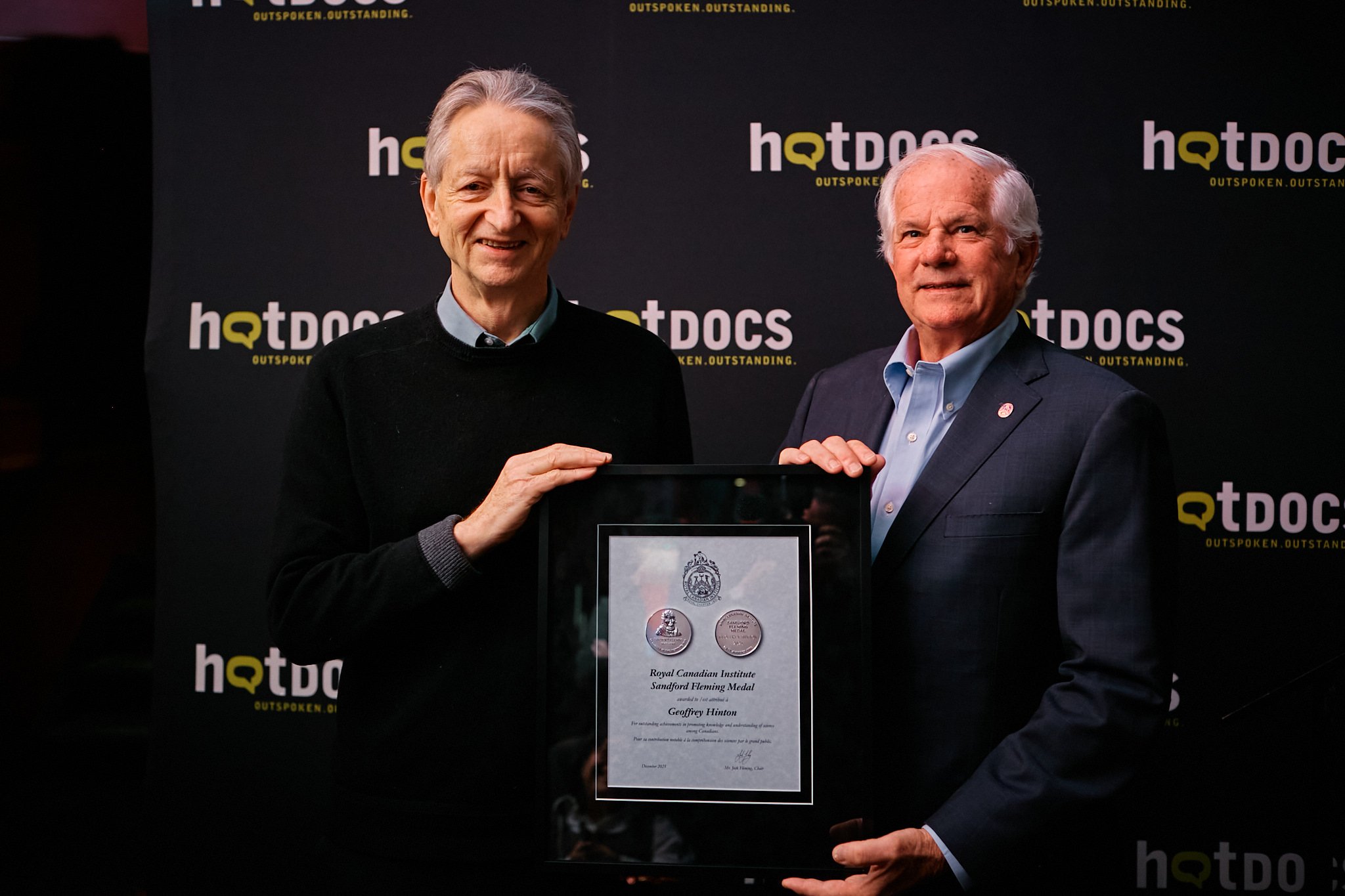
Geoffrey Hinton, University Professor emeritus in the Department of Computer Science at the University of Toronto, chief scientific advisor of the Vector Institute, and SRI strategic advisor.
Alondra Nelson, the Harold F. Linder Professor of Social Science at the Institute for Advanced Study, where she founded and leads the Science, Technology, and Social Values Lab.
Robert Prichard, chair of Torys LLP, visitor at Massey College, and president emeritus of the University of Toronto.
Heather Reisman, founder and CEO of Indigo Books & Music Inc.
Reeta Roy, president and CEO of the Mastercard Foundation.
Audrey Tang, Taiwan’s first Minister of Digital Affairs (2022–2024), Carnegie Distinguished Fellow at Columbia University’s Institute of Global Politics, and co-author of Plurality.
SRI Scientific Advisory Committee members
Ryan Calo, the Virginia and Prentice Bloedel Professor at the University of Washington, founding co-director of the UW Tech Policy Lab, and co-founder of the UW Center for an Informed Public.
Marian Croak, vice president of responsible AI and human-centred technologies at Google, and a member of the National Academy of Engineering, the National Inventors Hall of Fame, and the American Academy of Arts and Sciences.
David Danks, the Polk JSF Distinguished University Professor of Philosophy, AI, and Data Science at the University of Virginia, and an inaugural member of the U.S. National AI Advisory Committee.
Geoffrey Hinton, University Professor emeritus in the Department of Computer Science at the University of Toronto, recipient of the A.M. Turing Award and the Nobel Prize in Physics, and SRI strategic advisor.
Jacob Steinhardt, CEO and co-founder of Transluce, and associate professor of statistics and of electrical engineering and computer sciences at the University of California, Berkeley.
Richard Sutton, professor in the Department of Computing Science at the University of Alberta, research scientist at Keen Technologies, and chief scientific advisor of the Alberta Machine Intelligence Institute.
Shannon Vallor, the Baillie Gifford Chair in the Ethics of Data and Artificial Intelligence at the University of Edinburgh, where she co-directs the Centre for Technomoral Futures in the Edinburgh Futures Institute.
Want to learn more?
Browse stories by tag:
- AI
- AI safety
- AI trust
- Computer science
- Computer security
- Copyright
- Cybersecurity
- Data
- Democracy
- Economics
- Education
- Engineering
- Ethics
- GPO-AI
- Governance
- Health
- Human Rights
- In the Media
- Jobs
- LLMs
- Law
- Normativity
- Philosophy
- Political Science
- Privacy
- Privacy Series
- Psychology
- Public Policy
- Recommenders
- Regulation
- Religion
- Reports
- Trust
- Workshops