
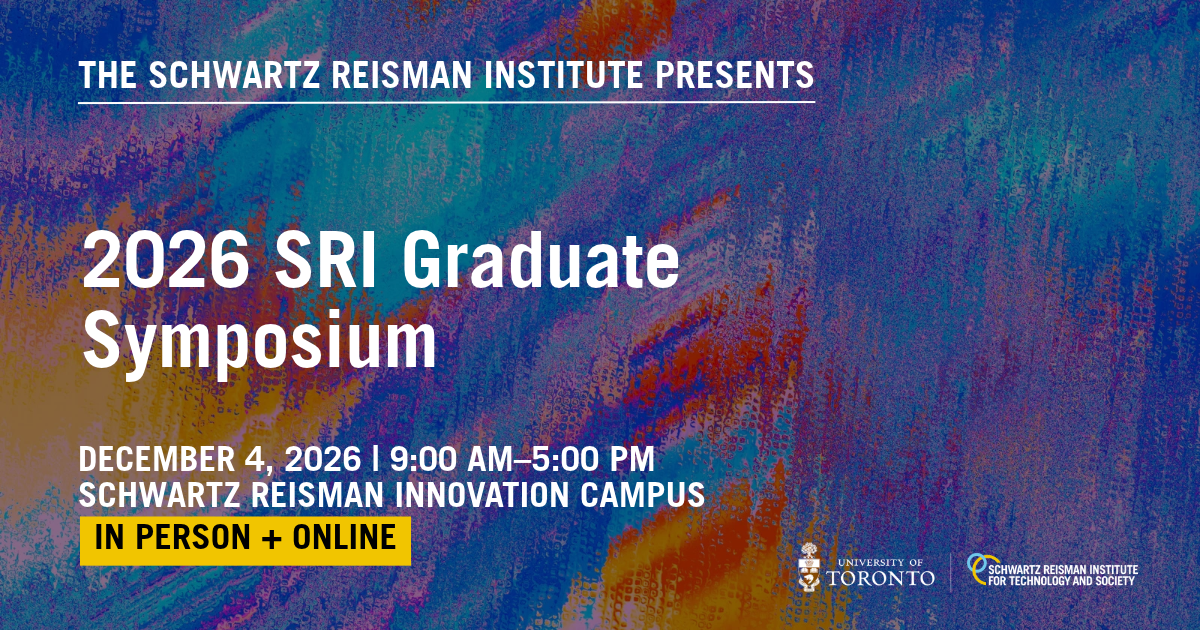
The 2026 SRI Graduate Symposium brings together a cohort of emerging scholars from across the University of Toronto to showcase cutting-edge research at the intersection of AI and society. Spanning computer science, law, public health, psychology, management, information studies, and the humanities, the symposium reflects the Schwartz Reisman Institute’s commitment to interdisciplinary inquiry and real-world impact.
Across five thematic panels, SRI graduate fellows will present research exploring how AI is reshaping human behaviour, governance, health systems, knowledge production, and culture. From the design of empathic and socially responsive AI systems, to the legal and regulatory frameworks that govern them, to applications in clinical decision-making and public health, the program highlights both the transformative potential of AI and the urgent challenges it raises. The symposium also foregrounds questions of equity and justice, examining whose knowledge is represented in AI systems and how frameworks rooted in relational and community-based perspectives can inform responsible design. It concludes by looking ahead to the future of work and creativity, addressing how AI is reconfiguring professional environments, cultural production, and human–machine collaboration.
Designed to foster dialogue across disciplines and perspectives, this event offers a snapshot of the next generation of AI and society research—grounded in technical innovation, informed by social and ethical analysis, and oriented toward building more trustworthy, inclusive, and accountable AI systems.
Event details:
Venue - in person: Schwartz Reisman Innovation Campus, Collaborative Learning Space (W240), Second Floor, 108 College. St., Toronto, ON, M5G 0C6
Venue - online: Online participation via Zoom (link sent to registrants).
Registration: Free to attend. In-person registration is limited.
Schedule:
9:00 – 9:30 AM | Registration & breakfast
9:30 – 9:45 AM | Opening remarks
9:45 – 10:45 AM | Panel 1: AI, society, and human behaviour
Frieda Rong (Department of Computer Science), “I see you, you see me?: Putting a face to a self-driving vehicle”
Patrick Yung Kang Lee (Department of Computer Science), “Memory, identity, and social dynamics in digital colleagues for knowledge work contexts”
Leif Anderson (Department of Psychology), “How does receiving AI empathy feel? exploring the perceived responsiveness of empathic AI”
10:45 – 11:00 AM | Break
11:00 – 12:00 PM | Panel 2: Governance, law, and regulation
Marco Germanò (Faculty of Law), “Law in the loop: Aligning and governing autonomous AI agents”
Sophia Jit (Department of Computer Science), “From case law to code: Context-sensitive specifications and guardrails for responsible AI”
Tracy Zhang (Graduate Department of Pharmaceutical Sciences), “Conceptualizing risks associated with using artificial intelligence in pharmacy practice”
12:00 PM – 1:00 PM | Lunch
1:00 – 2:00 PM | Panel 3: AI in health and clinical practice
Dariia Kucheruk (Department of Computer Science), “Beyond correlation: Learning meaningful representations for healthcare AI”
Gemma Postill (Institute of Health Policy, Management & Evaluation), “Phenotyping pre-injury health data with unsupervised machine learning to facilitate early prognostication of older adults’ long-term recovery after severe injury”
Sara Bocchinfuso (Institute of Health Policy, Management & Evaluation), “AI-assisted systematic reviews: A critical evaluation for responsible use”
Tracy Zhang (Graduate Department of Pharmaceutical Sciences), respondent
2:00 – 2:15 PM | Break
2:15 – 3:15 PM | Panel 4: Equity, knowledge systems, and responsible design
Md Arid Hasan (Department of Computer Science), “Digital memory or digital forgetting? LLMs and the fate of low-resource epistemologies”
Azhagu Meena (Faculty of Information), “Towards epistemically just design of LLMs-based mental health support for Indian working mothers”
Rowan O.A. Munson (Faculty of Information), “A toolkit for relational AI”
3:15 – 3:30 PM | Break
3:30 – 4:30 PM | Panel 5: The future of work and creativity
Shawn Meikle (Centre for Industrial Relations & Human Resources), “Designing safe AI at work: Joint health and safety committees as the front lines of AI governance”
Xingjian Zhang (Rotman School of Management), “The disclosure dilemma: Strategic revelation and trust in the age of AI”
Benjamin Pulver (Graduate Department of Art History), “Towards a new era of creativity: Conditions and politics of AI image-making”
4:30 – 4:45 PM | Closing remarks
4:45 – 5:00 PM | Reception and networking (in person only)
Speakers
Leif Anderson, PhD student, Department of Psychology
Sara Bocchinfuso, Master’s student, Institute of Health Policy, Management & Evaluation
Marco Germanò, SJD candidate, Faculty of Law
Md Arid Hasan, PhD student, Department of Computer Science
Sophia Jit, PhD student, Department of Computer Science
Dariia Kucheruk, PhD student, Department of Computer Science
Patrick Yung Kang Lee, PhD student, Department of Computer Science
Azhagu Meena, PhD student, Faculty of Information
Shawn Meikle, PhD candidate, Centre for Industrial Relations & Human Resources
Rowan O.A. Munson, PhD student, Faculty of Information
Gemma Postill, MD/PhD candidate, Institute of Health Policy, Management & Evaluation
Benjamin Pulver, PhD candidate, Graduate Department of Art History
Frieda Rong, PhD student, Department of Computer Science
Tracy Zhang, PhD candidate, Graduate Department of Pharmaceutical Sciences
Xingjian (Ken) Zhang, PhD candidate, Joseph L. Rotman School of Management
Moderators
Miron J. Clay-Gilmore, postdoctoral fellow, Institute for the History and Philosophy of Science and Technology
Ilya Grishchenko, postdoctoral fellow, The Edward S. Rogers Sr. Department of Electrical and Computer Engineering
About the Schwartz Reisman Institute
Located at the University of Toronto, the Schwartz Reisman Institute for Technology and Society’s mission is to deepen our knowledge of technologies, societies, and what it means to be human by integrating research across traditional boundaries and building human-centred solutions that really make a difference. The integrative research we conduct rethinks technology’s role in society, the contemporary needs of human communities, and the systems that govern them. We’re investigating how best to align technology with human values and deploy it accordingly. The human-centred solutions we build are actionable and practical, highlighting the potential of emerging technologies to serve the public good while protecting citizens and societies from their misuse. We want to make sure powerful technologies truly make the world a better place—for everyone.